


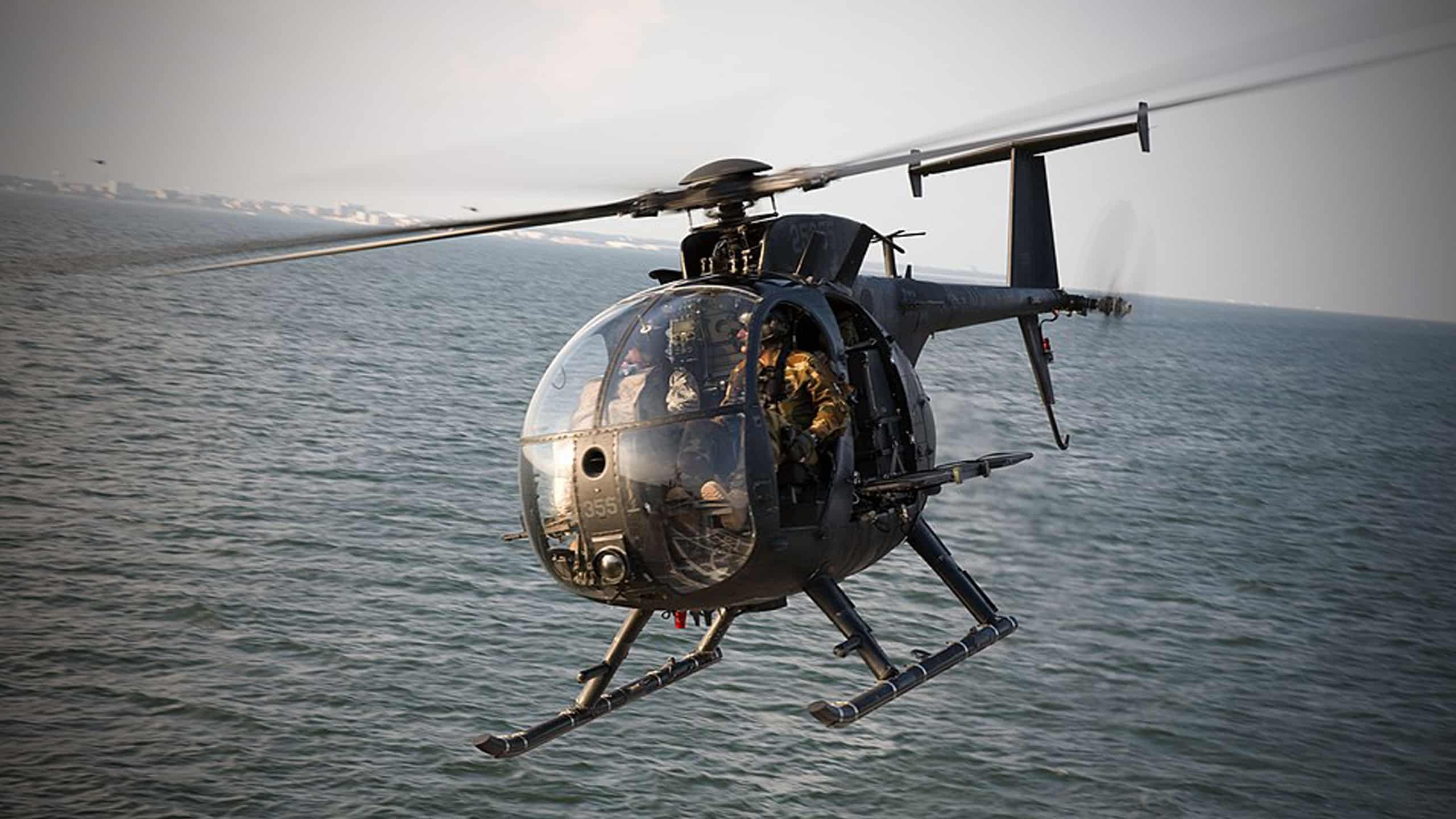
In 1960, the U.S. Army published a proposal for a new light observation helicopter to replace its Bell H-13 helicopter fleet, which was the Army’s primary helicopter during the Korean War.
The Hughes helicopter company responded with its Model 369 to compete against entries from Bell and Fairchild-Hiller. The Hughes entry made its first flight in 1963. The design featured an egg-shaped fuselage that had excellent visibility for the crew, and the four-bladed articulated rotor gave it great agility.
In the end, Hughes was victorious, and the Model 369 received its military designation, the OH-6. Since the Army names its rotorcraft after Native American tribes, it was called the Cayuse. As the Cayuse was used as an observation helicopter, it also received the official designation as a Light Observation Helicopter, or LOH, but the soldiers decided “Loach” was better.
Hughes OH-6 Cayuse
In 1964, all U.S. Army fixed-wing aircraft, such as the Cessna O-1 Bird Dog, were transferred to the U.S.A.F. The U.S. Army would use helicopters, including the incoming Hughes OH-6, for observation and reconnaissance.

In 1966, the OH-6 Cayuse began service in the Vietnam War, usually paired up with an AH-1 Cobra gunship as a hunter/killer or “Pink Team”. The Cayuse would fly low and slow, looking for the enemy. If fired upon, an observer would drop smoke to mark their position, and the Cobra gunship would then go to work.
Read an incredible story about an OH-6 pilot in the Vietnam war here.

In 1976, the Hughes 500 helicopter, a civilian and foreign sales version of the OH-6, introduced several advancements to the design. It featured a more powerful engine, a T-tail replacing the original V-tail, a new five-blade main rotor, and a four-blade tail rotor.
AH-6C
Following the United States Invasion of Panama in 1989 and the loss of helicopters attached to the Night Stalkers, work began on an armed version of the Cayuse. The OH-6 was redesignated as the MH-6 for transporting personnel with the SOAR light assault company, and the AH-6C was designated as a gunship for the light attack company. The AH-6C was fitted with the GAU-19/A, a three-barrel rotary heavy machine gun fires the .50 caliber BMG cartridge.
Boeing MH-6 & AH-6 Little Birds
The MH-6 and AH-6 were explicitly designed for use by the 160th SOAR, aka the Night Stalkers. The Little Bird’s tiny size is an asset to the Night Stalker mission. It allows landing in areas too confined for larger helicopters, like the Black Hawk or Chinook. Another plus is that they are small enough for easy transport to forward staging areas by U.S.A.F. airlift. They offer military planners the ability to provide fast insertions and extractions of special operations units.

While helicopters are not stealthy by nature, the small size of the MH-6 does make it harder to detect than larger aircraft, giving the Night Stalkers the element of surprise. Another feature is the commonality between models. The AH-6 can be quickly converted into the MH-6, and vice versa.
The latest model MH-6M variant is unarmed and features outboard “benches” designed to carry up to three operators on each side. It’s powered by a 650-horsepower Allison T-63-A-5A turboshaft engine, which gives the MH-6 a top speed of approximately 175 miles per hour and a range of 250 miles. It’s been upgraded with a six-bladed main rotor for enhanced agility and fitted with an infrared night vision system.

Live The Armory Life. The latest content straight to your inbox plus an automatic entry to each of our monthly gun giveaways!
The AH-6 is a gunship variant that’s painted black for nighttime operations. Its armament options include 2 GAU-19 .50 caliber gatling guns or 2 M-134D miniguns, 2 LAU-68D/A 7 round rocket pods carrying 2.75 inch Hydra 70 rockets armed with high-explosive incendiary or flechette anti-personnel warheads, and 4 AGM-114 Hellfire missiles, or FIM-92 Stinger missiles.
A/MH-6R Mission Enhanced Little Bird (MELB)
The AH-6 platform is now over 40 years old, and some think it is a little outdated, leading to a search for a replacement. For several years, it was believed that the Little Bird replacement would be the Future Attack Reconnaissance Aircraft (FARA). The Army was supposed to pick the winner between the Sikorsky Raider X and the Bell 360 Invictus.

While these new helicopters might be a suitable replacement for the AH-6, the problem is that the MH-6 carries operators. While the Raider X has a passenger compartment for up to six troops, the Invictus has no capability for passengers. The other issue is that both of these entries were larger than the MH-6, which would limit their ability to operate in confined spaces, like the Little Bird.
The FARA was intended to replace the AH-6, as well as the MH-60 Direct Action Penetrator; however, with its cancellation, the AH-6 will remain in service for a little longer. Fans of the “Killer Egg” (as it is known), of which there are many, are pushing to retain the AH-6 platform for a long time with the latest version, the block 3 A/MH-6R Mission Enhanced Little Bird (MELB).
This new variant features a brand-new fuselage with a 15-year guaranteed service life that increases the gross weight to up to 5,000 pounds. Previously, fuselages were purchased, and expensive add-on kits were installed to strengthen the fuselage structure and increase the gross weight to 4,700 pounds.

Allegedly, this weight increase is not for adding more features, but simply an extra safety margin for the crews. Now that might be the intent of the increase, but you and I know that if soldiers can take extra ammo with them they are going to take extra ammo with them, and a Carl Gustaf only weighs about 15 pounds. Pushing that gross weight over the 5,000-pound limit will be easy.

Other modifications include an updated Forward Looking Infrared (FLIR) system and an Aviation Management System, which will facilitate quick and easy future system integration. The MELB upgrades will keep the little bird in business into the foreseeable future and give the U.S. Army time to figure out its next move.
Legacy
It is sure that the Night Stalkers will be at the forefront of any future battles. Having an asset like the Little Bird makes the mission safer. It’s a battle-proven platform that’s simple and works. The pilots love this helicopter, the operators love this helicopter, so why not continue the program? War is serious business, and you need every possible advantage. As the saying goes, if you’re not cheating, you’re not trying.
Editor’s Note: Please be sure to check out The Armory Life Forum, where you can comment about our daily articles, as well as just talk guns and gear. Click the “Go To Forum Thread” link below to jump in and discuss this article and much more!
Join the Discussion
Read the full article here