


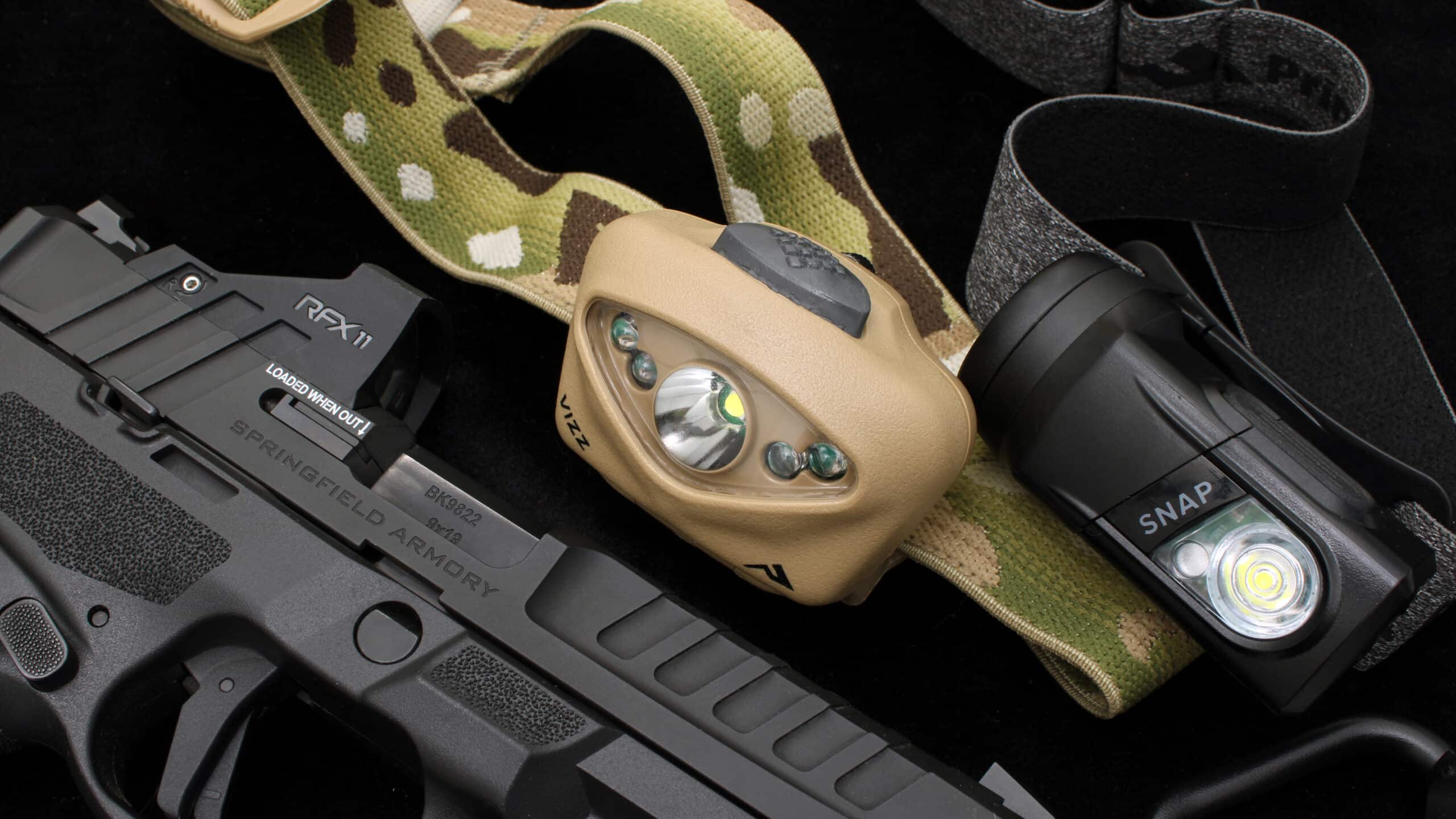
It’s been interesting to watch what’s happened in the tactical illumination market over the last few decades. I’d argue we’re seeing a rough equivalent to Moore’s Law, whereby flashlights become exponentially more powerful every couple of years. With that, there’s now a good number of consumers who are conditioned to think that when it comes to lumens, bigger numbers are always better.
Don’t get me wrong: if you’re shining an illumination tool into the eyes of someone trying to cause you bodily harm, then brilliant, blinding light is handy indeed. However, if you’re trying to change a fuse or do some repair work around the house, blowing out your own vision with thousands of reflected lumens is less than ideal. By the same token, hunters and other outdoorsmen may not necessarily want to change night into day every time they turn on a light source.
Today, I’m happy to share two well-considered headlamps from Princeton Tec that solve a number of problems and avail themselves to the user not with raw power, but through thoughtful, intuitive design.
Snap 450 RW Kit
When you take this unit out of the box, the first thing you’re going to notice is that it comes with a lot of pieces. The main lamp is a light that’s about two inches long and about an inch and a quarter in diameter. Press the button once and the lamp will come on with a 10 lumen red light; tap it again and it will engage the 450 lumen white light, which can be dimmed by pressing and holding the button to the user’s desired output.

What makes the light special is its adaptability. The bottom of the Snap 450 RW is outfitted with a magnet that will allow you to stick it to a metal surface. However, that same magnet can secure it to any of the other three housings, including not only the headlamp mount, but also a carabiner-compatible housing and a handlebar attachment. The carabiner housing has two different attachment points, which allows the beam to be projected straight downwards or parallel with the ground, and in practice the handlebar mount can be secured around any cylindrical object about an inch thick.

Suffice it to say that with all of these various configurations, you’ll be able to rig this little light exactly where you want it with a little ingenuity. Alternately, cyclists will appreciate the ability to secure the bike mount for rides while still being easily able to detach the light for any other illumination task. The same goes with hikers and joggers, who can clip the light to their person or backpack and retrieve it when needed.

If you want a good indicator of the level of care that Princeton Tec puts into its products, consider the strength of the magnet. In any of the housings, I really tried to whip the unit to see if it could be unintentionally dislodged through a normal range of human motion. No dice. However, the magnet isn’t overtuned; it’s easy enough to intentionally pull the lamp out of the various mounts without feeling like you’re fighting with it.

Live The Armory Life. The latest content straight to your inbox plus an automatic entry to each of our monthly gun giveaways!
The more time I spent with the Snap 450 RW, the more I liked it. As of late, I’ve been clipping it to my belt loop so I have an easy-access flashlight for nighttime walks. If you’re looking for a solution that gives you an illumination option without fighting for already-crowded pocket space, you might also dig it in that configuration.
Vizz 550 RGB
The second of the headlamps in today’s review is undoubtedly aimed more specifically at outdoors and tactical use. I’ll admit that when the Vizz 550 RGB arrived at my doorstep, I didn’t think I’d have much use for the three other wavelengths beyond the main white light bulb. Now that I’ve taken a little more time playing around with the unit in total darkness and reading up on a few of the benefits of the red, green, and blue outputs, I think the functionality is really neat.

First, the red light: it’s a color that’s minimally disruptive to your night vision, so if you’re in a low-light environment and don’t want to be disoriented when the light is switched off, this is a good choice. Green light is a wavelength that our eyes are naturally sensitive to, so we’re able to detect more details in the environment at the same intensity of light, making it good for navigating terrain and for detecting movement. Most animals, however, can’t easily perceive green light, so it excels when you want to maneuver without spooking game. Lastly, blue light is often used by crime scene investigators because it allows blood and other fluid to stand out more visibly than it would through other wavelengths. As a result, it’s an asset when tracking wounded prey.
Naturally, the Vizz 550 RGB also has white light capability; once the unit is engaged in any of the RGB modes, the user can hold the main button to engage the main bulb at 80% of max power. Pressing and holding the button a second time will cause it to dim, then ramp back up again.

While hunters, soldiers, and police officers will find oodles of utility here, The reason I really like the Vizz 550 RGB is because it’s a gunsmithin /tinkering headlamp par excellence. The unit is hinged at the front, allowing one to pivot the light at just the right angle, eliminating the need to crane your neck to illuminate your workspace. For those “wish I had a third hand” cases, it’s hell of a lot more useful than sticking a pen light in your mouth!
Even More to Like
Past the individual feature sets of both the Snap 450 Kit and the Vizz 550 RGB, there are quite a few other things I liked that the units had in common. Both have an easy “lockout” mode that wasn’t at all fiddly. Hold the power button for five seconds, and either unit will put itself into a state where it can’t be turned on by a single button press, making it nearly impossible to turn on if it’s accidentally bumped or smooshed by the other contents in one’s gear bag. The same long press puts it back in action.

Each of the headlamps came with an elastic band that I found very comfortable to use for long periods. Both units were also less than 3.5 ounces, so it didn’t feel like there was a dense protrusion sticking out from my forehead — another plus. These lamps also feature waterproofing (IPX7 certification on the Vizz550 and IPX4 certification for the Snap 450), so despite the light weight they’re sufficiently rugged.
Battery life was also impressive for both models. On the lowest illumination setting, the Vizz 550 RGB will run for 75 hours; the Snap 450 will stay on for 100 hours. I also want to note that in an era where it seems like everyone’s cheaping out wherever possible, Princeton Tec packaged both headlamps with Duracell batteries. They’re mission ready as soon as you get these things out of their containers.
Final Thoughts
Princeton Tec is no stranger to the world of illumination; they’re a supplier to the United States Military (the Navy SEALs, in particular) and they have a half-century of experience making the kinds of tools that stand up to adventuring and the needs of first responders. Also, all of Princeton Tec’s products are designed and manufactured right here in the USA. Since it was founded, it has remained a family-owned company.
Both of these headlamps evince a great deal of care and thoughtfulness; I have no doubt that most of our readers will find either (or both) of these units very much to their liking, and well-suited to a number of different missions.
Editor’s Note: Please be sure to check out The Armory Life Forum, where you can comment about our daily articles, as well as just talk guns and gear. Click the “Go To Forum Thread” link below to jump in and discuss this article and much more!
Join the Discussion
Featured in this article


Read the full article here