
A lot of people suggest that the Stuart tanks were underpowered for World War II. While this may be true when compared to tanks like the Panzer IV, the platform was still able to bring significant firepower to the battlefield in the form of the M8 Howitzer Motor Carriage.
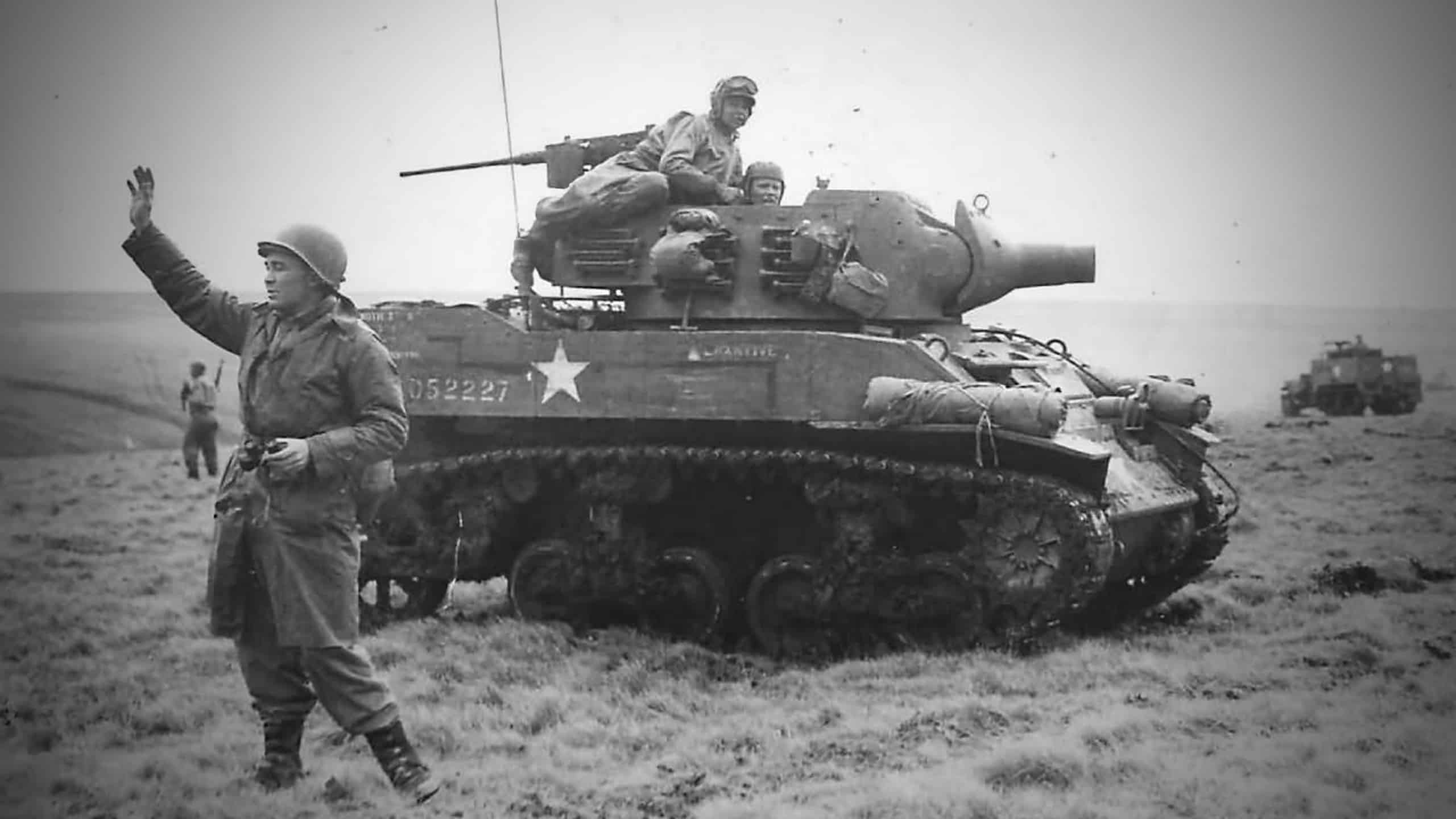
The M8 Howitzer Motor Carriage was a self-propelled howitzer vehicle used by the United States Army. Built on the M5 Stuart light tank chassis, the M8 mounted a 75mm howitzer in an open-topped turret configuration.
Similar to the M7 Priest used to support armored units, the M8 Howitzer was intended to provide mobile indirect fire support in mechanized cavalry reconnaissance squadrons. Fast-moving recon units couldn’t wait for towed artillery to catch up and deploy. When these units called for artillery support, they needed it right now.

The Cadillac Division of General Motors built nearly 1,800 M8 Howitzers by the end of the war. Crews took these motor carriages into battle across Europe and on many islands of the Pacific Campaign. While they lacked the “oomph” of the larger 105mm guns found on the Priest, the M8 could deliver critical firepower support to units probing enemy defenses.
Development from M3 Stuart Experiments
Initial attempts to create a self-propelled howitzer on a light tank chassis began with the T18 Howitzer Motor Carriage in late 1941. Envisioned as a self-propelled gun to provide close support, the T18 combined an M3 Stuart chassis with a 75mm pack howitzer in a fixed forward position. The howitzer mount was designed using the M3 Lee medium tank’s 75mm gun mount as inspiration.

However, the configuration proved unworkable. The gun placement far forward made the vehicle nose-heavy and prone to tipping during movement over rough terrain. The fighting compartment was cramped, and the crew had inadequate protection. The project was canceled, and the prototypes were destroyed after the war.
Keeping with the concept, engineers moved to the newer M5 Stuart chassis for the T41 project. The M5 featured twin Cadillac V8 automobile engines producing some 220 horsepower. These more conventional engines replaced the radial aircraft engines used in the M3. Importantly, the Cadillac V8 engines were paired with automatic Hydra-Matic transmissions that made them easy to drive and easy for new crewmen to learn.

The M5 chassis also incorporated a raised rear engine deck, improved sloped armor on the glacis plate, and a more spacious fighting compartment. But the T41 still had a nose-heavy problem. Additional testing and revisions moved the gun into a better position, but the competing T47 project’s approach is what won the contract for Cadillac.
Instead of a fixed fighting compartment, engineers designed the T47 with a manually rotated, open-topped turret that could traverse a full 360 degrees. This turret configuration solved multiple problems simultaneously. It distributed weight more evenly across the chassis. It provided far better crew protection than fixed mounts. It gave tactical flexibility — the crew could engage targets in any direction without repositioning the entire vehicle. After successful testing of the T47 mockup, the design was designated T17E1 HMC and ordered into production as the 75mm Howitzer Motor Carriage M8.
Design Changes from M5 Light Tank
The M8’s hull was essentially the M5 Stuart with specific modifications to fit the howitzer. The forward hull-mounted Browning M1919A4 .30-caliber machine gun was deleted. This created additional interior space for ammunition storage — critically important since the 75mm rounds were substantially larger than the 37mm ammunition carried by standard Stuart tanks.

The driver and assistant driver compartment hatches, originally located on the top of the hull, had to be relocated to the glacis plate because the larger turret ring blocked their original positions. These new hinged plates could be rotated upward for visibility or lowered to button up for protection.
The turret was fabricated from cast steel and was open-topped to help vent gun gases and reduce weight. The turret front measured 1.5” thick with rounded surfaces. The sides and rear were a little thinner at 1” thick. This turret was considerably larger than the M5’s to accommodate the howitzer’s recoil mechanism and provide working space for the crew.
75mm Howitzer Gun
The M8’s primary armament was the 75mm howitzer mounted in the M7 mount. Early production vehicles received the 75mm Howitzer M2, an adaptation of the M1 Pack Howitzer. Later-production M8’s were equipped with the 75mm Howitzer M3.

Maximum firing range reached approximately 8,800 meters (~5.5 miles). The howitzer was relatively low velocity, designed for high-angle indirect fire rather than flat-trajectory direct fire. The gun had a good range of elevation: plus 40 degrees up and minus 20 degrees down. This elevation range proved particularly valuable in mountainous terrain.
A total of 46 rounds of 75mm rounds could be distributed throughout the vehicle. Six of these were “ready” rounds positioned between the driver and assistant driver positions for immediate access.

Live The Armory Life. The latest content straight to your inbox plus an automatic entry to each of our monthly gun giveaways!
The most common ammunition types were the M48 high explosive shell and the M89 white phosphorus shell. The M48 HE round was the standard anti-personnel and general-purpose projectile. The M8 could also fire the M66 HEAT round, which could penetrate 3” of armor plate, giving limited anti-tank capability when necessary, though this was not the vehicle’s primary role.
Secondary Armament
Unlike the standard M5 light tank, the M8 featured no coaxial machine gun. The only vehicle-mounted machine gun was a Browning M2HB .50-caliber heavy machine gun positioned on the right rear corner of the turret. This weapon had 400 rounds of ammunition. The .50 caliber’s mounting provided generous traverse and elevation, and its heavy punch made it effective against a wide range of targets.

For personal defense, crew members carried individual weapons. The driver was often issued a Thompson submachine gun or M3 grease gun — useful in the close confines of the driver’s position and for dismounted combat if needed. The other three crew members (commander, gunner, and assistant driver/loader) were typically equipped with M1 carbines.
Speed and Operational Range
The M8 weighed approximately 18 tons in combat configuration. Maximum road speed was roughly 36 miles per hour. This was somewhat slower than the M5 Stuart it was based on, due to the increased weight of the larger turret and ammunition load. However, it remained highly mobile compared to medium tanks or towed artillery. This made it great over the beach and in rough terrain.

Operational range was approximately 160 kilometers (100 miles) before it needed to find a gas station. Units frequently carried extra fuel in jerrycans.
Italian Campaign and Normandy Operations
The Howitzer Motor Carriage M8 first saw its combat in 1943 during the Italian Campaign. Italy’s mountainous terrain was extremely challenging for conventional armor. The M4 Sherman medium tank, though effective, struggled with the steep slopes and narrow mountain roads.

At roughly half the Sherman’s weight, the M8 could navigate terrain where heavier vehicles bogged down. Its high-angle fire capability was perfectly matched to mountain warfare where targets were often on hillsides above or below the firing position.

In France following the Normandy invasion, M8’s equipped the assault gun troops of numerous cavalry reconnaissance squadrons. During Operation Cobra and the subsequent breakout from the Normandy hedgerows, the cavalry squadrons played crucial roles in exploiting penetrations and screening the flanks of advancing armored divisions.
Pacific Theater Employment
The M8 also served in the Pacific Theater. Though in smaller numbers than in Europe, they proved every bit as effective. Jungle trails were narrow. Amphibious operations required relatively lightweight vehicles that could be landed quickly.

White phosphorus rounds were particularly effective against bunkers, as the burning phosphorus would penetrate openings and make positions untenable.
Replacement by M4 Sherman 105mm Assault Gun
Production of the M8 ended in January 1944 after 1,778 vehicles were manufactured. The decision to halt production came as more capable systems became available. The primary replacement was the M4 Sherman medium tank mounting the 105mm M4 howitzer, designated the M4 (105) or assault gun version of the Sherman.

The transition from M8 to Shermans began in early 1944 as production of the latter ramped up. However, M8’s already in service continued to be used through the end of the war.
Post-War Service with French Forces in Indochina
After World War II, the United States provided M8’s to several allied nations. France received M8 vehicles during and after the war. The French Army deployed these M8’s to Indochina as part of the French Expeditionary Corps during the First Indochina War from 1946 to 1954.

In Indochina, the M8 found a role similar to its Pacific service in World War II. French forces faced an insurgency operating from jungle bases and fortified villages. The M8’s mobility allowed it to support mobile operations and convoy escort missions.
The M8 remained in French service until the early 1960s, seeing action in Algeria during that conflict as well. After being withdrawn from French service, some vehicles were transferred to South Vietnamese forces. Other nations that received surplus M8’s included Cambodia, Laos, the Philippines and Taiwan.
Yugoslav Partisan Use
During World War II, Yugoslav partisans received nine M8 vehicles, which they nicknamed “Kadilak” after the Cadillac engines. These vehicles were used in operations against German and Croatian forces in the later stages of the war. The M8’s provided the partisans with mechanized firepower they otherwise lacked, as most partisan forces relied on captured equipment and light weapons.
M8 Scott Nickname
In November 1944, the U.S. Army Ordnance Department issued an official directive assigning nicknames to various military vehicles for publicity purposes and media usage. The M8 received the nickname “General Scott” or simply “Scott,” honoring General Winfield Scott.

General Scott served in the U.S. Army during the 19th century and fought in the War of 1812, various Indian Wars, and the Mexican-American War. He was a prominent military figure in American history, and this naming followed the Army’s pattern of naming vehicles after famous generals.
However, historical evidence suggests the nickname “Scott” was primarily used in official documentation and public relations materials rather than by troops in the field. Post-war, the “Scott” nickname became more widely used by historians.
Final Thoughts
The M8 filled a specific operational need during a critical period of the war. Its service in Italy, France and the Pacific demonstrated the importance of mobile fire support for rapidly moving mechanized units.

While overshadowed by more famous vehicles, the M8 played its role effectively and contributed to Allied tactical success in multiple theaters. Its extended post-war service with various nations attested to its basic soundness as a weapons system even if it was deemed outdated against a major power.
Editor’s Note: Be sure to check out The Armory Life Forum, where you can comment about our daily articles, as well as just talk guns and gear. Click the “Go To Forum Thread” link below to jump in!
Join the Discussion
Read the full article here