
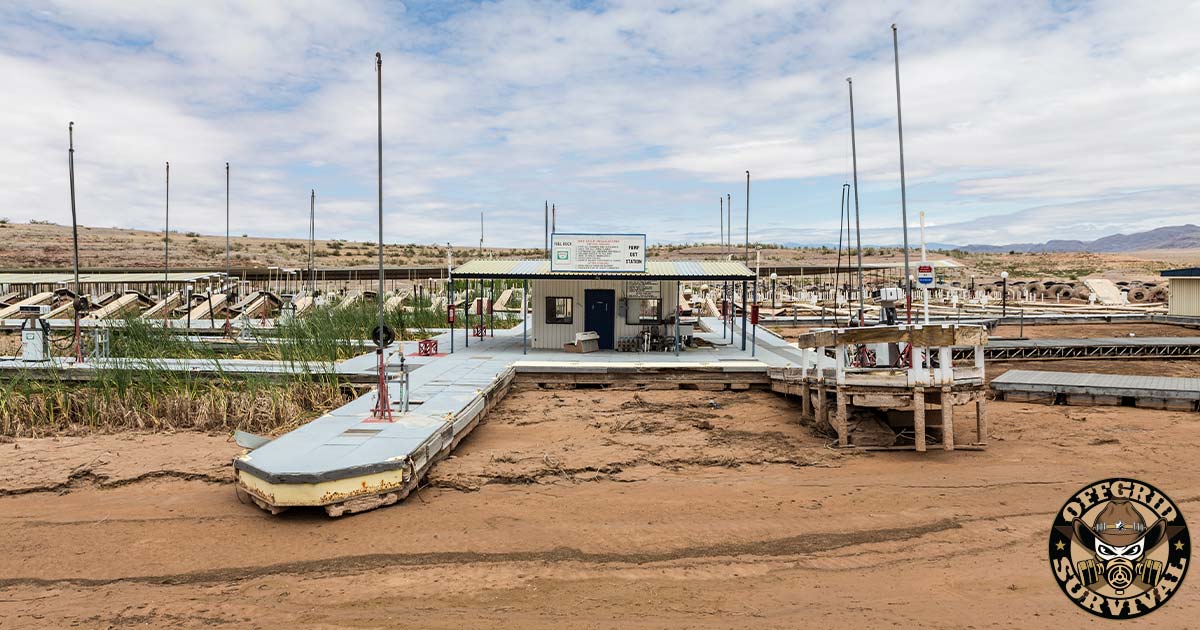



Lake Mead just dropped to the lowest level ever recorded since Hoover Dam created the reservoir.
Late Thursday into early Friday, the lake fell to roughly 1,040.5 feet above sea level, breaking the previous record low from 2022, according to Bureau of Reclamation data reported by ABC News. The Las Vegas Review-Journal tracked it as low as 1,040.46 feet.
Government records disagree by a few tenths of a foot over exactly which number counts as the old record. Who cares. The reservoir is lower than it has ever been, and federal forecasts say it is going lower.
Current projections have Lake Mead falling to around 1,015 feet by next summer, another 25-foot drop. That matters when the reservoir supplies roughly 90 percent of Southern Nevada’s drinking water and helps support a Colorado River system used by 40 million people.
The Water Problem Is Becoming a Power Problem
Hoover Dam does more than hold back water. It generates electricity, and lower water levels mean less pressure through the turbines and less power coming out of the dam.
Federal officials are preparing for Hoover Dam’s output to fall by as much as 40 percent, meaning utilities will have to replace that cheap power somewhere else. That cost does not disappear. It eventually lands on ratepayers.
Boulder City Councilman Steve Walton has pointed to 1,035 feet as an important threshold for Hoover’s generators. Lake Mead is now only about five feet above it.
“That’s the magic number,” Walton said. “That’s when they expect that hydropower production will decrease for head-pressure reasons. But that’s theoretical. They are not entirely sure.”
That is not exactly reassuring when we are talking about the power system serving one of the hottest regions in the country.
“We are in a water catastrophe right now,” Walton said.
And Somehow This Is the Perfect Time for Another Data Center
While all of this is happening, the Bureau of Land Management approved a data center project on federal land inside Boulder City’s jurisdiction.
Boulder City says the federal government did not even bother consulting the city before approving it.
“We were not reached out to by the BLM to be included in the decision,” City Attorney Brittany Walker told the council.
The city council voted unanimously to appeal the approval, warning that the project could create new demands on local power, water, infrastructure and emergency services.
Residents have been saying the same thing.
Brynn deLorimier, who started a petition against the project, told the Review-Journal that the project was being pushed through despite local opposition.
Another resident told the council her biggest concerns were simple: water and electricity.
And that is the part bureaucrats always pretend does not exist. Moving a project onto federal land does not magically create more water or more electricity.
This Is What Scarcity Looks Like When Government Controls your Faucet
The Colorado River has been overpromised for decades, and the people in charge have spent years pretending they could manage their way around the math. Now Lake Mead is at a record low, Hoover Dam is getting dangerously close to levels that could hammer power production, Nevada is staring at more cuts, and the seven states that depend on the river still cannot agree on what happens next.
That alone should be enough to make people nervous. But what should really piss people off is watching the same government that lectures homeowners about conservation turn around and approve another massive industrial project that could put even more strain on local water and power.
People in Southern Nevada are already being told to rip out grass, watch every gallon they use, accept higher utility costs and pay penalties if they cross whatever line the water district sets. Meanwhile, the big projects keep getting approved and the people who actually live here are expected to make up the difference.
That is the part nobody should ignore. When shortages get worse, the people making these decisions are not going to be the first ones asked to sacrifice. They are going to keep squeezing residents, raising rates, tightening restrictions and calling it conservation while the biggest users somehow keep finding room at the table.
Related reading:
Read the full article here