
Communication is something most of us rely on constantly without giving it much thought. In everyday life, instant connectivity is assumed. We text, call, navigate, check weather, and share our location without hesitation. The moment that connectivity disappears, its absence becomes immediately apparent. When you step outside normal infrastructure, whether hiking, hunting, camping, or preparing for emergencies, communication shifts from convenience to necessity. In those moments, the ability to signal, transmit information, or call for help can have real consequences.
Anyone who spends time in remote terrain understands how quickly conditions can change. Weather shifts unexpectedly, injuries happen, vehicles fail, and plans unravel. Even experienced outdoorsmen can find themselves dealing with problems that were not part of the original plan. The good news is that off-grid communication options today are better, more accessible, and more reliable than they have ever been. The spectrum ranges from simple, electricity-free tools that have been saving lives for decades to advanced satellite-based systems that were largely unattainable for civilians not very long ago.
This is not about chasing the newest or most advanced technology for its own sake. It is about proven tools that earn their place in a pack through reliability, simplicity, and real-world usefulness. The communication methods covered here are ones I have integrated into my own hunting, hiking, and emergency preparedness kits because they work, they are intuitive under stress, and they provide layered capability when traditional communication infrastructure is unavailable.
The Basics
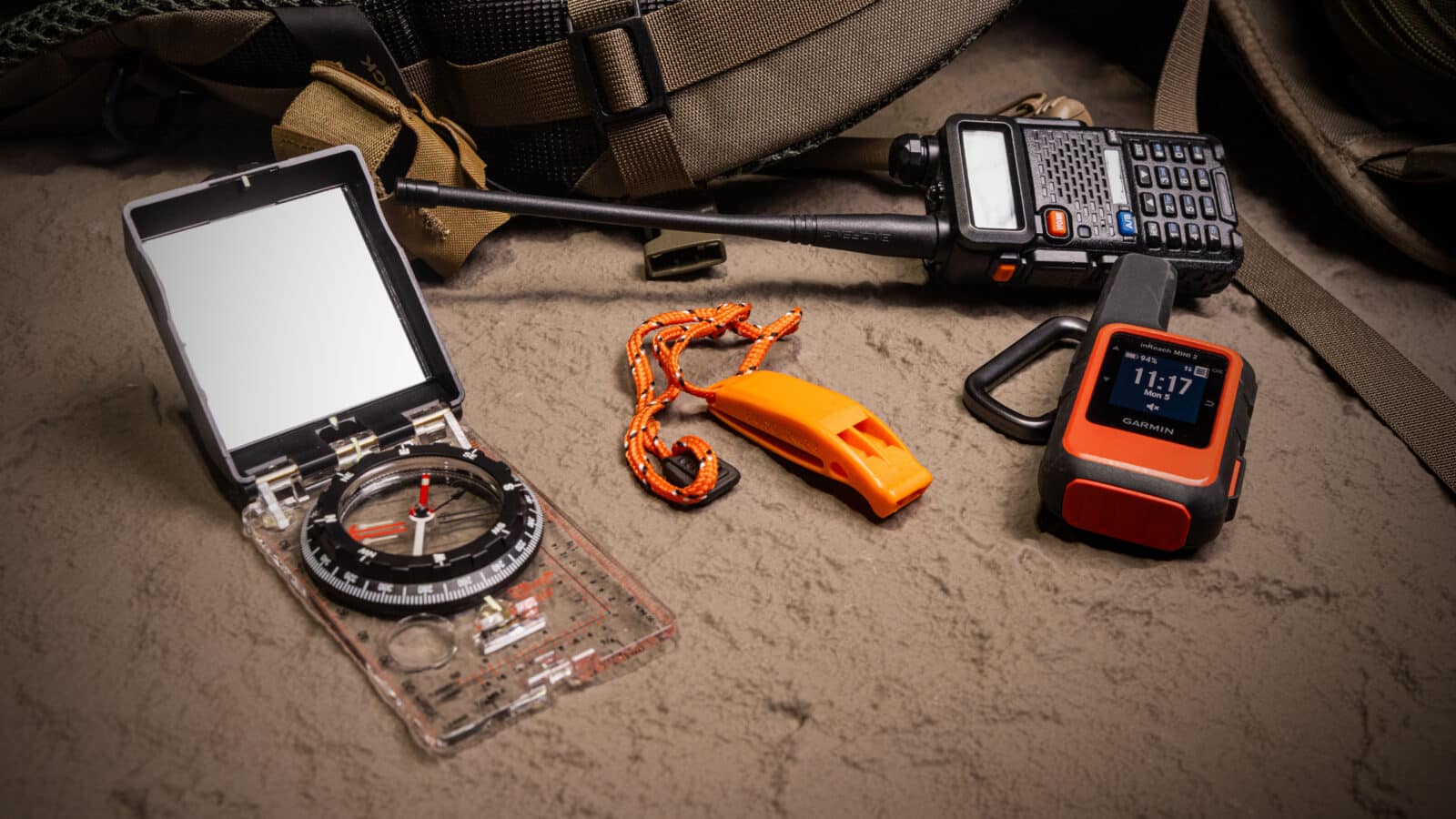
Before diving into modern technology, it is worth starting with the most basic forms of off-grid communication. Simple tools still matter because simplicity is often what makes them reliable. Signal mirrors and whistles are two of the most overlooked pieces of emergency equipment, yet they remain among the most dependable. Neither requires batteries, cell coverage, subscriptions, or ongoing maintenance beyond keeping them accessible.

A signal mirror is one of the most effective visual signaling tools available when sunlight is present. A properly aimed mirror can reflect light over long distances and can be detected from the ground or from the air. In open terrain, desert environments, alpine areas, or anywhere with direct sunlight, a mirror allows someone in distress to draw attention to their location repeatedly.
I typically carry a small compass and signal mirror combination unit because it serves more than one purpose while taking up very little space or weight. In an emergency situation where movement is limited or self-rescue is not an option, the ability to visually mark your position can be critical. These tools are simple, durable, and have proven their value for generations.
A whistle serves a different but equally important role. It provides audible signaling with minimal physical effort. When someone is injured, fatigued or dealing with environmental stress, yelling for help is inefficient and often ineffective. Vocal calls require significant energy and depend on the ability to project sound consistently. A whistle produces a sharp, high-pitched tone that carries farther than the human voice and cuts through background noise more effectively, all while requiring very little effort to use. Whistles are also widely recognized as distress signals, making them effective for drawing attention if others are nearby but out of sight.
Shining the Light
A headlamp with built-in SOS and strobe functions is another simple but highly effective addition to an off-grid communications kit. Illumination is the primary role, obviously — navigating in low light, managing camp tasks, or handling gear after dark — but the signaling capability is where it really earns its place.

An SOS mode provides an automated distress signal in the universally recognized three-short, three-long, three-short pattern. That removes guesswork and ensures consistency under stress. A strobe function adds a highly visible, attention-grabbing flash that can be seen from significant distances at night and can help rescuers or teammates quickly pinpoint your location.
Unlike a whistle or mirror, a headlamp gives you 360-degree visibility in low-light environments and doesn’t rely on sunlight. In a backcountry emergency, especially after dark, that added layer of visual signaling can be critical. When evaluating one for your kit, prioritize battery life, water resistance, impact durability, and simple, intuitive controls that can be operated with gloves.

Live The Armory Life. The latest content straight to your inbox plus an automatic entry to each of our monthly gun giveaways!
Like the other tools we’ve discussed, it’s not about complexity — it’s about layered capability. A dependable headlamp with SOS and strobe functions bridges the gap between illumination and signaling in one compact, lightweight package.
Reaching Out
Handheld radios are another useful off-grid communication tool, particularly when operating as a group. Often referred to as walkie talkies, these radios allow direct communication between users without relying on cellular networks or satellites. When terrain and conditions allow, radios can provide immediate, real-time communication that is difficult to replicate with other tools.

Radio performance is heavily influenced by terrain, line of sight, power output, and antenna quality. Range can vary significantly depending on environmental conditions, and advertised distances rarely reflect real-world use in wooded, mountainous, or built-up areas. Battery life is also an important consideration, as higher transmit power and frequent use will drain batteries more quickly. Legal compliance matters as well, as different radios fall under different regulatory frameworks with specific power limits and licensing requirements. Equally important is ensuring that everyone involved understands how to use the radios they are relying on. Radios are only effective if all parties are familiar with the equipment and have agreed on channels and expectations ahead of time.
While radios are not a replacement for emergency signaling tools or satellite communication, they can be a valuable supplement when coordination within a group is required. Used appropriately, they add another layer of capability to a well-rounded off-grid communications plan.
Ultra-Long Range
Modern technology has significantly expanded what is possible beyond analog and short-range tools. One of the most impactful developments in recent years has been the integration of satellite communication capabilities into everyday smartphones. For a long time, once cellular coverage disappeared, a phone became little more than a camera and a GPS device. That is no longer the case.

Many current smartphones now offer satellite-based emergency communication and messaging. Not long ago, satellite phones were expensive, bulky, and out of reach for most people. Today, satellite messaging capability exists inside devices many of us already carry every day. I have personally used satellite messaging on a modern smartphone during a hunt in a remote area with no cellular coverage. When the phone detected the lack of service, it prompted satellite communication options automatically and provided clear on-screen guidance to align the device with the nearest satellite. Within minutes, I was able to send and receive messages and confirm that emergency services would be reachable if needed.
This capability adds meaningful peace of mind, particularly on shorter trips where carrying a separate satellite device may not always feel necessary. While smartphone satellite messaging has limitations compared to dedicated satellite communicators, it provides valuable redundancy and another way to maintain contact when cellular infrastructure is unavailable.
For trips that push farther into remote terrain, I rely on a dedicated satellite communicator. The device I personally use is the Garmin inReach Mini 2, and it has become a permanent fixture on my pack. This is the satellite communications tool I trust most when I know cellular coverage will not be available. The inReach Mini 2 provides global satellite coverage and allows for two-way text messaging regardless of location, which makes it useful not only in emergencies but for routine communication as well.
One of the most important features of the inReach Mini 2 is its interactive SOS capability. In an emergency, activating SOS connects you with a staffed emergency response coordination center that can communicate back and forth with you. That two-way communication allows you to provide details about your situation and location, which can significantly improve response effectiveness. Battery life is another reason this unit earns its place in my kit. With conservative tracking settings, it can operate for days at a time without recharging, making it well suited for multi-day hunts, extended hikes, and trips where access to power is limited.

At the highest end of the off-grid communication spectrum is satellite internet. This is where communication shifts from basic signaling and messaging to full connectivity. Portable satellite internet systems have fundamentally changed what is possible in remote locations. What was once limited to government, military, or specialized commercial use is now accessible to civilians at a realistic price point, and the technology has matured to the point where it can be integrated into outdoor and preparedness use without excessive compromise.
I personally run a Starlink Mini for off-grid communications, and it has been a genuine game changer in terms of capability. Its compact size and relatively low power demands make it viable for base camps, remote cabins, overland setups, and emergency scenarios. In my setup, the Starlink Mini is powered using a combination of portable battery solutions, including StarBatt and a high-capacity external battery pack. This allows me to maintain communications without relying on generators or grid power and provides flexibility depending on the duration and nature of the trip.

With a clear view of the sky, the Starlink Mini provides reliable broadband internet access in places where cell service does not exist. This enables voice calls, messaging, weather monitoring, mapping, and real-time coordination from nearly anywhere. While this is not a system most people will carry deep into the backcountry on foot, it fills a critical role for base camps, vehicle-supported travel, disaster response, and sustained off-grid operations.
Conclusion
When evaluating off-grid communication options, the most important takeaway is that no single tool does everything. The most effective approach is layered capability. Simple tools like whistles and mirrors function when everything else fails. Radios allow group coordination. Smartphones with satellite messaging add redundancy. Dedicated satellite communicators provide reliable emergency and routine messaging. Satellite internet systems offer full connectivity when extended or sustained communication is required.
When you are off the grid, communication becomes a lifeline. Choosing tools that are proven, reliable, and appropriate for your use case is one of the smartest investments you can make. Whether your kit lives in a backpack, a hunting rig, or an emergency bin at home, having multiple ways to signal and stay connected ensures that when things go wrong, you are not relying on a single point of failure.
Editor’s Note: Please be sure to check out The Armory Life Forum, where you can comment about our daily articles, as well as just talk guns and gear. Click the “Go To Forum Thread” link below to jump in and discuss this article and much more!
Join the Discussion
Featured in this video


Read the full article here