





Today’s red-dot sights are a far cry from those of yesteryear, which wasn’t all that long ago. We’ve come a long way fast.
History is fascinating. A look into the past often feels like shaking hands with someone long dead. Some inventors were ahead of their time with an intellectual panache limited only by their place in history. Like da Vinci’s helicopter, their inventions could not get off the ground without supporting technology. The history of the red-dot sight or optical sight is long and filled with brilliant inventors and inventions.
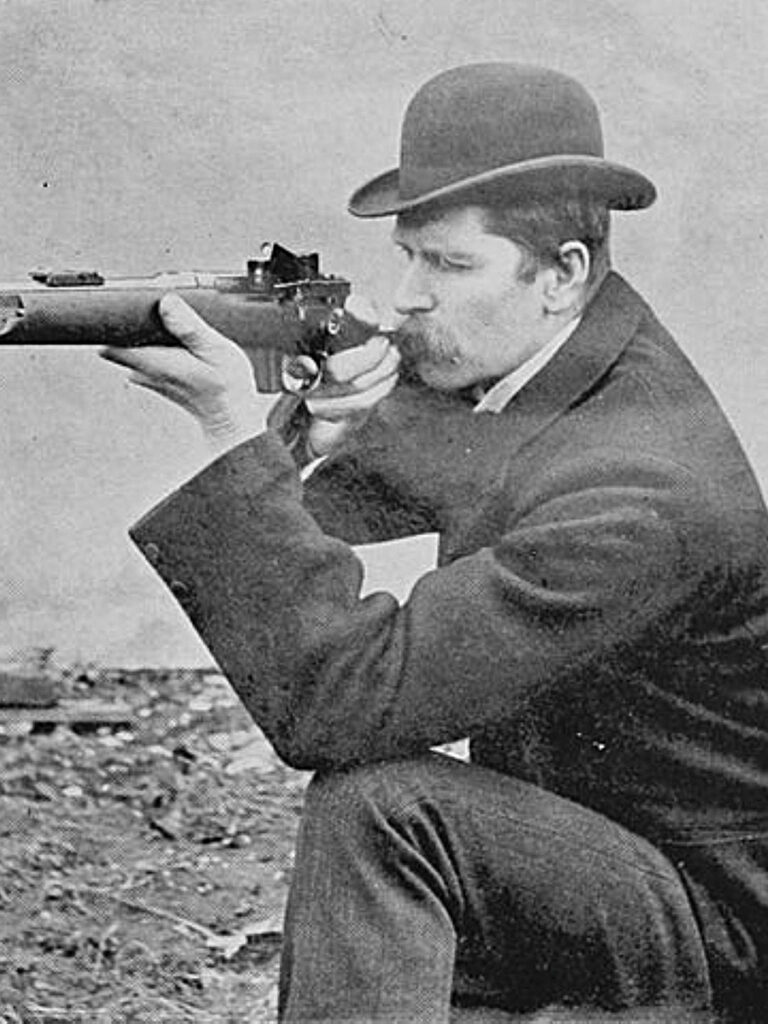
The optical sight was well on its way when mankind first began to grind glass, and with Sir Isaac Newton’s optical experiments. Practical innovation led to the first reflex sights around 1900. The problem addressed by the reflex sight was speed and accuracy with iron sights. While very accurate and well-designed iron sights were in practical use before 1900, they required extensive training to be effective.
One example was the Buffington rear sight used on the U.S. 1873 Springfield rifle. With graduated adjustments to 2,000 yards and an azimuth knob, the Buffington sight allowed real precision. But the basic problem of iron sights remained. The eye must focus on the front sight, keeping it sharp in focus. The rear sight was slightly blurred, and the target was not in sharp focus. This allowed for excellent accuracy, especially in the hands of trained marksmen.
However, not all the training was that good, and not all the rifles were that accurate. Long-range rifle fire was important at the time. The development of telescopic sights led to the creation of specialized snipers in every army by World War I. The reflex sight originated in 1900, according to patents by Howard Grubb. His 1901 patent shows a similarity to modern designs.
The 1901 patent diagram illustrates a relatively compact instrument compared to similar designs for cannon and artillery. I collect old cameras, and the optical similarities between some of the lenses and aiming devices are interesting. All are optics.
The Grubb sight used outside lighting; there was no battery. Light bounced into the sight through a relay mirror, then off a curved collimating mirror. The sight was apparently designed to compete with telescopic sights. At the time, telescopic sights were far less developed than today. Parallax error and low eye relief, as well as a small field of view, were the norm for telescopic sights. Then and now, a shooter pressing too close to the telescopic sight would get a crack across the brow when the rifle fired. A reflex sight with its unlimited eye relief does not share this defect.

By design, the reflex sight is best suited for shorter-range use. At the time, this was a shortcoming. Changing conditions of war revised the military’s outlook and made short-range optics viable for wartime use.
In the Grubb sight, natural light projects a fine beam onto glass. Grubb wrote that his sight was designed to align with the bore axis and allow accurate shooting. Grubb sights were not widely used, but they were an important step. As design progressed, the reflex sight was adopted for aircraft and anti-aircraft gun use more often than on firearms. The speed and accuracy of the type were recognized as advantages. With their single aiming point, the reflex sight was a significant advantage in fast-moving situations.
In the 1930s, considerable advances were made. The British realized that 300 mph engagement in fighter plane duels left no room for error and little time to land a heavy blow on the enemy. The eight-gunned Hurricane and Spitfire fighter planes demanded an advanced aiming device. The French and British developed reflector sights for fighter aircraft. If you have seen the classic Battle of Britain cinematic masterpiece, you saw these sights. In one scene, a pilot desperately tries to replace the bulb illuminating the sight. These sights featured gyroscopes in later versions to account for speed and angle of attack.
In the American adaptation, the N-series sights had two reticles. One was to identify the direction the guns were pointed; the other was to predict the impact. (Consider the Primary Arms Vulcan reticle a modern development on more or less the same theory.) These were highly advanced sights, far superior to anything the Axis countries had, and changed the face of aerial combat. By 1947, small arms sights with batteries were beginning to be designed. They were miniaturized for aircraft use to improve viability.
So, do we owe the popularity and development of modern red-dot sights to military developments, including aircraft sighting systems? Yes, we do. The advantage of the reflector sight is that the shooter can fire with both eyes open. Aim and fire, and you do not lose your field of view. The sight has a beam projected onto a curved lens. The curved lens allows for infinite eye relief. You aim, and the red dot is superimposed over the target. Press the trigger, and you have a hit—if the optic is sighted in correctly.
While the development of the red-dot sight is impressive, the optic as we know it was not possible until the perfection of light-emitting diode (LED) technology. The LED has revolutionized manufacturing across many optical applications. The red-dot, with its LED design and single point of aim, is more closely parallel to the bore than any other type of sight. This makes for excellent hit probability.
My impression of the similarity between camera viewfinders and red-dot sights was confirmed by research into the history of optical sights. Lieuwe van Albada developed a camera-aperture aiming device that led to a type of gunsight later used during World War II on the Bazooka rocket launcher. It seems that telescopic and reflex sights were combined in some instances experimentally just after WWII, the beginning of the optical instrument now known as a magnifier. Research and inventors are interesting, but perhaps the most amazing thing is what they have to work with. That is the human eye.
For a moment, consider the wonder of the eye: the cornea, iris, vitreous humor, lens, layered retina, rods, pigments that moderate light intensity, and, perhaps most important, the photoreceptors that relay information to the brain. Animals have the advantage over humans in certain areas, as their nerve fibers go directly out the back of the eye; ours pass through the retina first. This results in the blind spot we all have but seldom notice.
This construction is a marvel and makes using red-dot sights second nature. Perhaps there is some notion of hydromechanics in the eye; for certain, there is plenty of adaptability in humans and the ability to reorient to different types of firearms sights. Binocular vision, in particular, leads to the ability to fire with both eyes open—a special advantage of the red-dot sight.
Red-Dot Sights For Astigmatism
I have been blessed with good vision. Just the same, I learned a great deal about vision problems in dealing with my mother’s failing eyesight and in obtaining corrective lenses for my children. Sometimes, just a little help goes a long way. The old shooter’s joke that the front sight has melted or gotten fuzzy over the years is to the point. We cannot hit the target if we don’t see the aiming point clearly. According to the Atlanta, Georgia-based Centers for Disease Control, the most common vision problem among adults over 40 is astigmatism. This problem includes nearsightedness, farsightedness, and other problems related to refraction.
Only an optometrist can provide an accurate diagnosis. The thing about these issues is that 1 in 3 of us over 40 has an eye problem. When playing tennis, the problem may not be that serious. However, when firing a handgun, the usually well-defined sight can be blurred rather than in sharp focus, and that can become deadly serious.
Eye strain is common with astigmatism. So, visit the optometrist once a year, even if no problems are evident, and if necessary, obtain corrective lenses. The good news is that red-dot sights alleviate many of the problems associated with astigmatism. Some of us wear glasses when driving or reading, but not as a matter of course when shopping or hiking. With astigmatism, the red dot itself may be blurred to some extent, perhaps with a tail like a comet, according to some, or, in severe cases, the dot may appear as a double dot—although this seems more likely with cataracts.
Red-Dot Sights: The Great Equalizer
Do a few speed drills, and you will find that although the red dot may not be a perfect round dot, you are plenty accurate. The aiming point is far superior to an iron front sight. Practice a little with brightness settings. I ran the red-dot sight by several shooters who usually wear glasses, and they found it fine with unaided vision. Aging eyes, in general, are helped by red-dot sights, and certain forms of astigmatism, especially, are ‘canceled out’ by using a carry optic.
Red-Dot Sight Developments
Among the developments leading to the success of red-dot sights were a series of battery-free optics that used a fiber-optic collector. The Singlepoint of Vietnam fame and legend was among the first. While not powered by electricity, similar types featured a tritium insert for dim-light use. Development began during the 1960s, and they were used experimentally during the Vietnam War. These sights enabled quick firing with both eyes open in combat.
On the sporting side, the Weaver Qwik Point was a similar sight that saw some popularity on shotguns for sporting use. I have used them on .22 rifles as well. Within their limitations, they were fast and accurate. If you chose to use a Qwik Point, you were married to it, as the mount required the shotgun receiver to be drilled and tapped for the sight. If you discarded or broke the Qwik Point, you were left with unsightly holes in the receiver.


The Qwik Point was an innovation that moved us toward today’s red-dot sights. Its advantage was that there was no battery. But then, this was also a liability in dim light. Given the battery technology at the time, I don’t think I would have trusted any battery-powered device. The Qwik Point was not intended for tactical or defensive duty, so it was OK for its role as a recreational shooter and hunting accoutrement.
Research and development continued, and in 1975, Aimpoint introduced what is widely regarded as the first red-dot sight as we know it today. Swedish entrepreneurs, focused on improving speed and accuracy, introduced a highly successful red-dot sight. The Aimpoint Electronic was not only innovative but also high-quality and effective. Sometimes a company’s first products are less than stellar. This wasn’t the case with the Aimpoint. It came out of the box running and performed well. There have been improvements, and the original is outdated, but it served as the avatar for the rest of the world during development. It was a rifle sight, but miniaturization was to come.

Howard Grubbs’ ideas were the best possible with the technology available in 1900. Using a natural light source, the device was limited to daylight use. The device’s acceptance was also limited by attitudes of the day. The changing face of warfare and the need for a fast-operating system capable of delivering rapid hits eventually led to weapon-mounted red-dot sights. As often happens, wartime demands lead to amazing technology. The reflex sight was the ideal choice for fighter aircraft and had been highly developed by the end of World War II.
The modern reflex sight features an LED that reflects light directly onto the sight’s lens. When aiming, there is no attempt to line up the target with the front and rear sights; close one eye. With the red-dot optic, the aiming point superimposes on the target. With some sights at very long range, the front sight subtends and obscures the target. This isn’t a problem with the red-dot sight. The line of sight is clearer.
Electronic sights were eventually developed that were compact enough for mounting on handguns. Handgun sights were particularly in need of improvement. The rub was, even in the infancy of the repeating handgun, that some pistols were accurate enough for long-range fire. Texas Rangers routinely engaged enemies at 100 yards, although the .36-caliber Colt wasn’t powerful enough to inflict a great deal of damage at this extended range. The .44 Dragoon was another matter. I have fired the wonderfully accurate 1858 Starr revolver at a long 100 yards with near-100 percent certainty of striking a man-sized target. But most handguns used small sights that were difficult to line up correctly.
Eventually, better types were developed, but they had the shortcomings of all iron sights. A handgun is much more difficult to fire accurately than a rifle, and when the need for speed is added, we have a serious tactical problem.
The red-dot optic first caught on in competition. With the spread of freedom and a hard-won fight for the right to carry concealed handguns, affirmed by many states, citizens were taking their handguns seriously for self-defense. This led many shooters to compete and to be exposed to competitors using optical sights. The apparent advantages were not lost on defensive shooters.

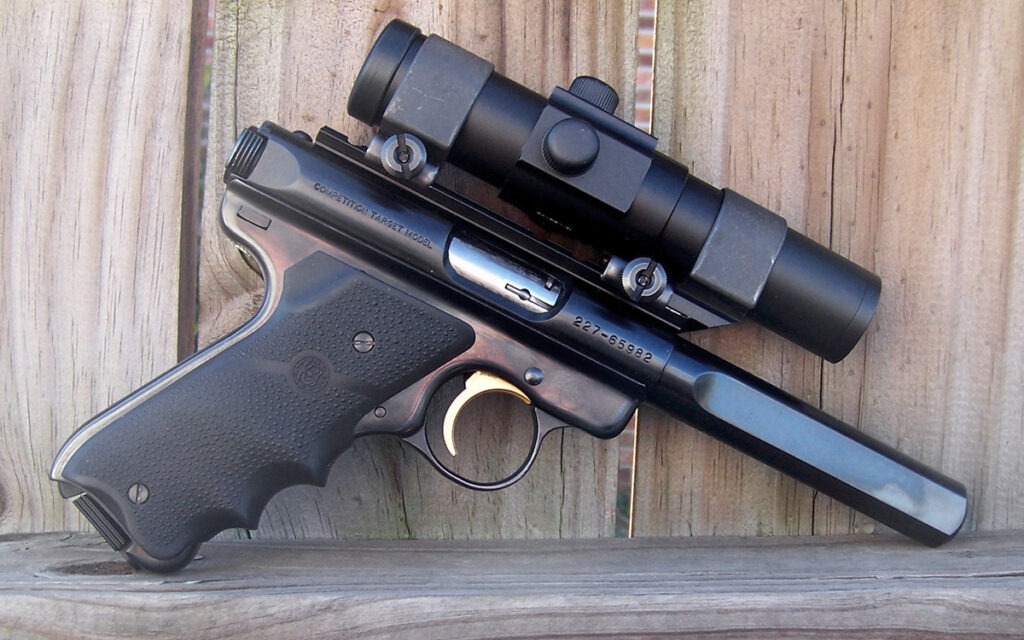
A good shooter with iron sights will have a transition period when adopting red-dot sights. Some take to them more quickly, but training results in a smoother, faster shooter. The tacit expectation is of increased accuracy in speed shooting. The most significant advantage is seen when the shooter engages multiple targets.
This was initially proven in IPSC and USPSA contests, where the technology for adapting reflex sights to handguns was developed. The red-dot became an essential tool. Combat focus is much faster. Firing with both eyes open allows the shooter to focus on the threat while maintaining a much wider field of view. Even firing at night is faster and more accurate as the red-dot sight maintains its aiming point in all conditions.
A significant advance in practical red-dot technology came with the invention of the Picatinny mount. This rail, also known as the M1913, provides a stable, easy system of mounting optical sights on rifles and later shotguns. Several handguns also feature this mount, primarily target-grade rimfires. Milling the slide of a pistol to mount optical sights was common by the 1990s. There was no going back. The pistol was then permanently red-dot sighted.
The invention and evolution of slide plates, culminating in the Glock MOS and other models, made mounting a red dot much easier. Modern red-dot sights would not be viable without the CR2032 battery. This lithium metal non-rechargeable 3 Volt battery has a modulated output and incredible battery life. Up to 50,000 hours of battery life is possible. Realistically, a life of about half that is to be expected if you run the optic on higher settings.
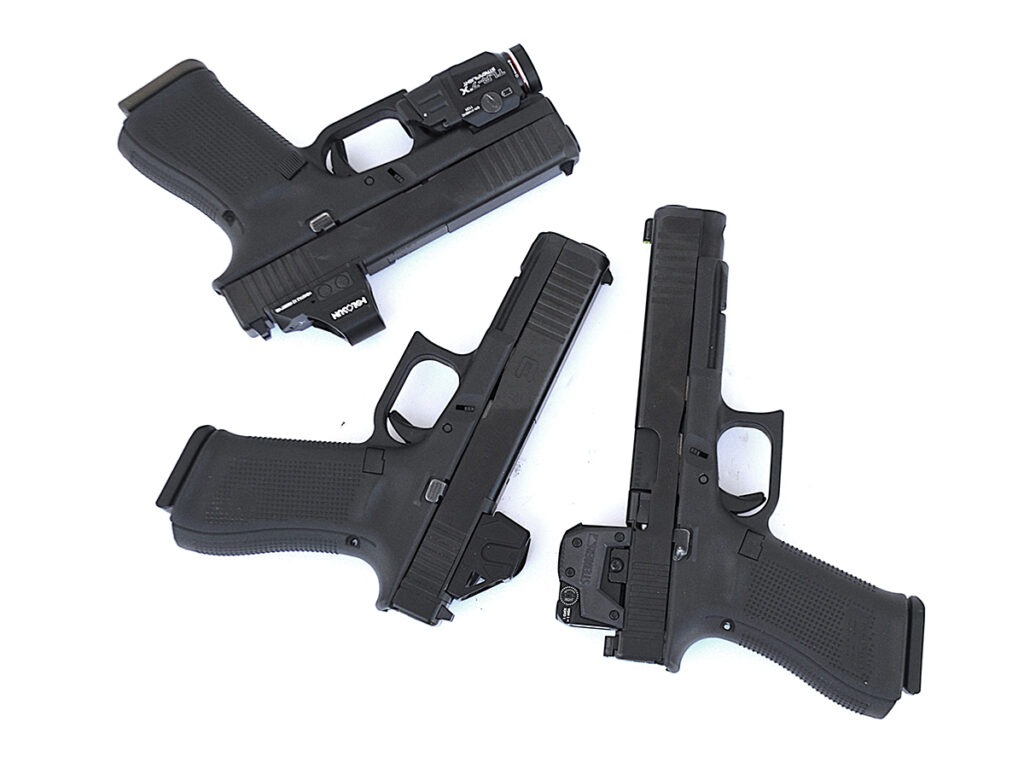
In fact, a 10,000-hour lifespan has been confirmed when the red-dot is left on its highest setting continuously. That is a tremendous technological advance. Mounts and batteries were developed in tandem with red-dot technology, forming a modern, reliable optic. We are well away from the then-useful but comically large, ill-balanced pistol reflex sights of the 1990s. The carry optic is highly evolved.
Editor’s Note: This article is an excerpt of Gun Digest’s Optics Ready: Red-Dot Sights For Modern Handguns.
More Red-Dot Sights


Next Step: Get your FREE Printable Target Pack
Enhance your shooting precision with our 62 MOA Targets, perfect for rifles and handguns. Crafted in collaboration with Storm Tactical for accuracy and versatility.
Subscribe to the Gun Digest email newsletter and get your downloadable target pack sent straight to your inbox. Stay updated with the latest firearms info in the industry.
Read the full article here