


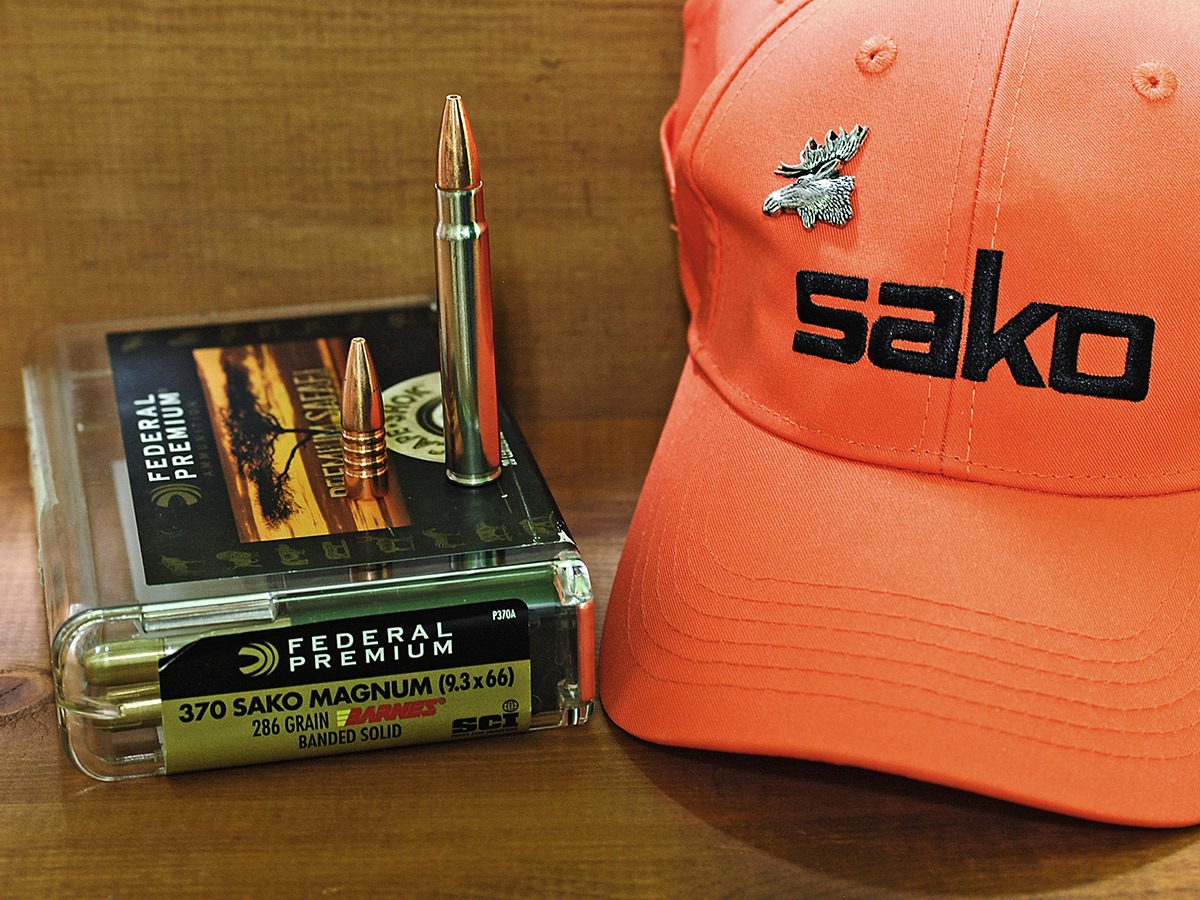
We take a deep dive into the .370 Sako Magnum, an excellent, hard-hitting big game cartridge from Finland.
The list of metric cartridges popular in America is short but sweet. Several, such as the 7×57 and 8×57 Mausers, plus the new and justifiably popular 6.5 Creedmoor, can be called classics. But the larger calibers have been mostly absent. Enter the .370 Sako Magnum.
The .370 Sako is actually a 9.3mm, a caliber popular in Europe. I was originally infected by the 9.3mm bug in 2001 when I got a 9.3×62 Mauser. The .370 Sako was just more of the same. I don’t remember exactly where I first read about the .370 Sako, but in 2011, fate smiled upon me. I was invited on a moose hunt—in Finland.
Upon arrival in this Nordic country (to refer to Finland as a “Scandinavian” country is an insult), I was greeted by representatives of Sako and briefed on the traditional driven moose hunt of this region. Before you can hunt moose in Finland, you must pass the “running moose” shooting test. As a skeet shooter, I figured this would be a snap. I was issued a Sako Model 85 Black Bear chambered in .370 Sako. The Sako ammo was loaded with Nosler 250-grain Ballistic Tip bullets. Sako lists it at 840m/s, which is 2,756 fps. The muzzle energy of this load was a bone-crushing 4,217 ft-lb.
At the range test, I readied my rifle. The full-size moose target was, as I remember, at 90 meters. It “ran” first from right to left, then back to the left. Five shots were required. My first shot was a 9; piece of cake, says I. My next shot was a 3, but I ended up with an average score of 6.5, so I passed.
After the test, I talked to Pentti Louhisola, a senior Sako Product Advisor coordinating the upcoming hunt. I told him how impressed I was with the .370 round, and he asked if I would like to meet the man who designed it. Pentti introduced me to Erkki Kauppi, then Sako’s Cartridge Development Director. Kauppi described in great detail the development of the new round. He was obviously proud of his creation.
Essentially, the 9.3×62 Mauser case is lengthened by 4mm, but with some significant changes. First, the case was strengthened, and a “high-energy” powder gave it its prodigious power. The initial case was 68mm long, but was shortened to 66mm so that loaded cartridges would fit in bolt-action magazines. The overall cartridge length is 85mm (3.35 inches). The round was initially called the “9,3×66 EK,” for Erkki Kauppi. Three loads for the .370 are still listed in the Federal catalog, but its distribution is limited.
| Case Type | Rimless Bottleneck |
| Bullet diameter (in.) | .366 |
| Case neck diameter | .363 |
| Shoulder diameter | .450 |
| Case base diameter | .477 |
| Rim diameter | .468 |
| Case length | 2.598 |
| Cartridge length | 3.350 |
| Shoulder angle | 17½ degrees |
The next day, it was off to the hunt. In Finland, hunting is more about the process than the actual harvest. Hunters are placed in elevated stands at strategic locations several hundred yards apart in a line. Then beaters, some with their “moose dogs,” start toward the stands, making as much noise as possible. Hunters can’t shoot just any moose. There was a point system. Bulls and cows without a calf were each “one point.” A cow with a calf was on the ”no shoot” list, and a calf was one-half point. The “limit” for our group was one point.
The driven hunt was quite an experience. I had a good vantage point from my stand, and soon a cow and a half-grown calf started across the field from my right in front of the stands. Suddenly, the cow skidded to a stop and scrutinized the blaze-orange-clad hunters in the stands. After thinking it over, she did a 180-degree turn and ran. In her frenzy to flee, she literally ran over the calf, flattening it. However, the calf quickly gathered itself, and soon both were out of sight.
Later, a bull appeared from my left. A legal one-pointer! I shouldered my rifle, chambered a cartridge, and launched an offhand barrage of lead. After three shots, the bull hit the ground. My guide, Max, soon appeared, and said that the shot was about 140 meters. He covered my three bullet holes with the palm of his hand. Hey, that “running moose” test paid off.
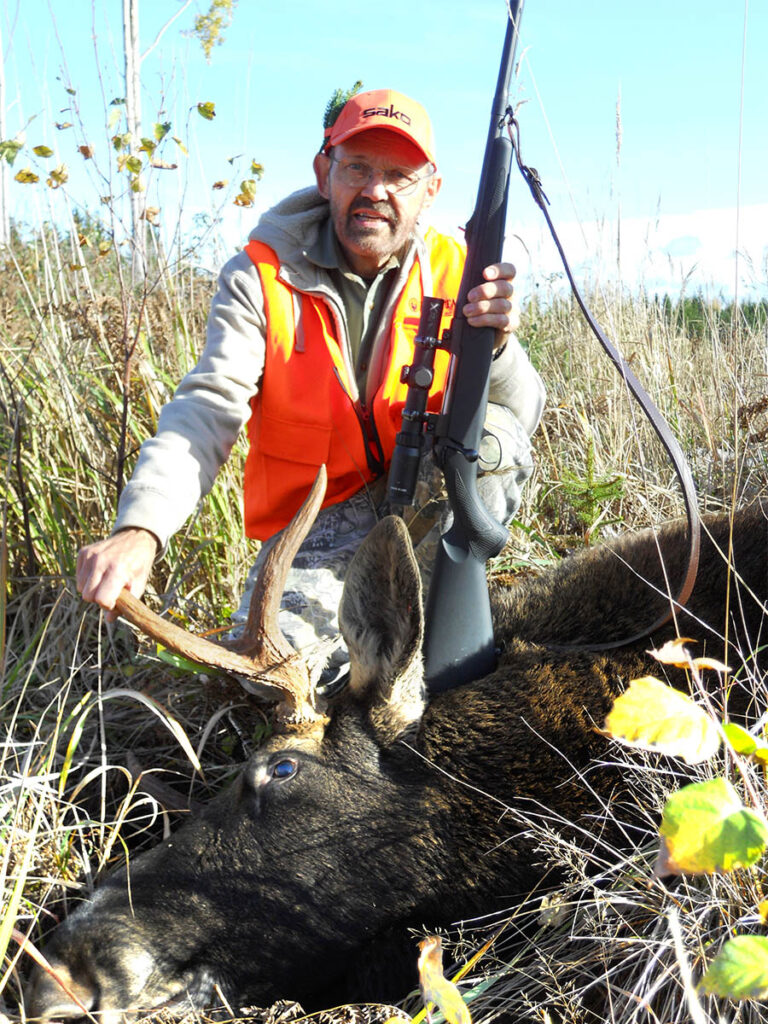
I asked Max what we would do next. He said he’d call the “moose processing people,” and they’d remove the moose and process it. Moose are another farm product that is sold. Moose and reindeer are on the menus of most restaurants in Finland.
.370 Sako Up Close
The .370 Sako has an interesting history that will be familiar to seasoned American hunters. It is reminiscent of John A. Nolser’s 1946 experience, hunting moose in British Columbia. The bullet from his .300 H&H Magnum failed to bring down a moose, so Nosler designed a “better bullet.” The result was the famous Nosler Partition.
On the other hand, Kauppi—the .370 Sako’s developer—has been a civil engineer employed by the Sako Cartridge Department in Riihimäki, Finland, since 1971. He is an avid hunter and a serious shooter. In 1989, he was hunting moose during a typical weekend party hunt. The beaters kept nearing his stand, and suddenly, a nice bull appeared in front of him. Kauppi put a 180-grain 30-06 bullet behind the bull’s heart when it ran past him. Even though the bullet was well-placed, the big bull continued almost 300 yards, when another hunter in the party shot it again. The bull collapsed, and that shooter claimed Kauppi’s moose.
Kauppi wanted a better caliber that would not allow a “dead moose” to run hundreds of yards after a solid hit. He could have purchased a .338 Win. Mag. or .375 H&H Mag., but he wanted something with a smaller action. Both of these calibers were in Sako’s production, but he did not like what he called the “bulkiness” of the magnum action.
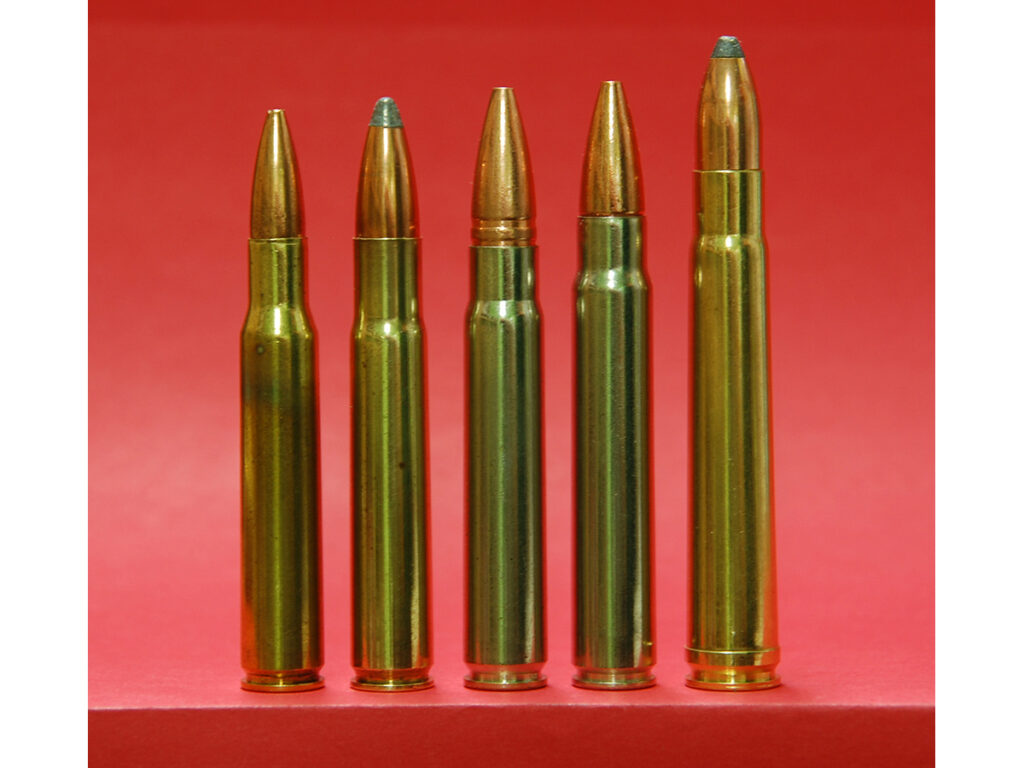
The Sako L61R/IV action has a fixed magazine that can handle a maximum cartridge OAL of 85mm (3.346 inches). Kauppi made a beltless and rimless case 4mm longer than 9.3×62 but maintained the other dimensions. However, he redesigned the case to handle higher chamber pressures.
Kauppi’s design was first called 9,3×66 E.K., but since he worked as Sako’s Cartridge Department Director, it was decided in 2002 that the factory would introduce and catalog the cartridge as the “9,3×66 Sako Magnum,” and the dimensions, pressures, etc., were taken to the CIP (Commission International Permanente) for approval.
In 2002, Sako introduced four factory loads: 250-grain Nosler Ballistic Tip, 286-grain Sako Hammerhead RN (Bonded), 286-grain Barnes Triple Shock-X and the 286-grain Barnes Solid. The cartridge’s energy and penetration levels are practically equal to the famous .375 H&H Magnum, but the beauty is in the smaller-sized action.
The 9.3×66 Sako case cannot be made from other existing cases but is of conventional design. The dimensions in inches are as follows:
Drew L. Goodlin, Director of Technology, Strategic Product Development at ATK Civil Ammunition (Federal), wanted the name to be “Americanized” since stateside hunters are not familiar with metric. Thus, in 2006, Federal adopted the 9.3×66 and called it the .370 Sako Magnum for the American market. Federal’s Maximum Average Pressure (MAP) for the round is 60,000 psi, somewhat higher than for the 9.3×62 Mauser (55,000 psi).
The Test Rifle
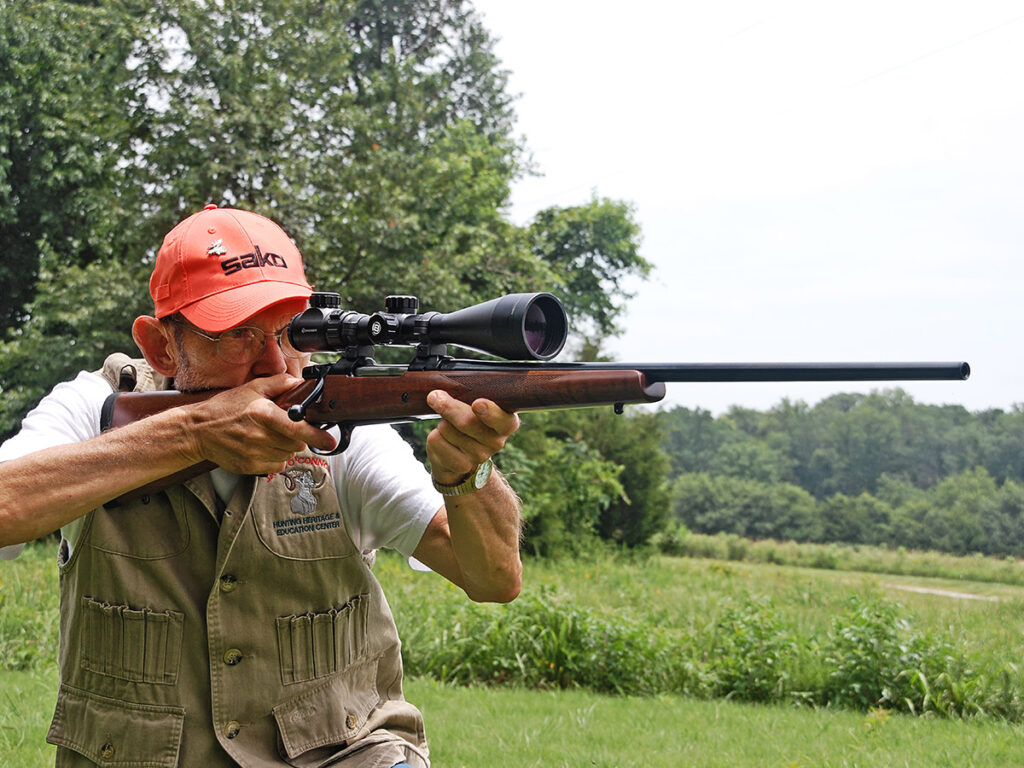
Since 2001, I had owned a CZ Model 550 American in 9.3×62 but didn’t want to modify it, so shortly after returning from Finland, I bought another one in 9.3×62 and had it rechambered to .370. The result is an accurate powerhouse. For example, in his book Africa’s Most Dangerous, Kevin Robinson rates the 9.3×66 Sako a bit higher in killing ability than the .375 H&H. Craig Boddington used a .370 on Cape buffalo and noted the round’s effectiveness on bulls—and its reduced recoil. He stated that the .370 is similar to the 375 H&H in power, but more like the .35 Whelen in recoil. What’s not to like?
Loading and Shooting
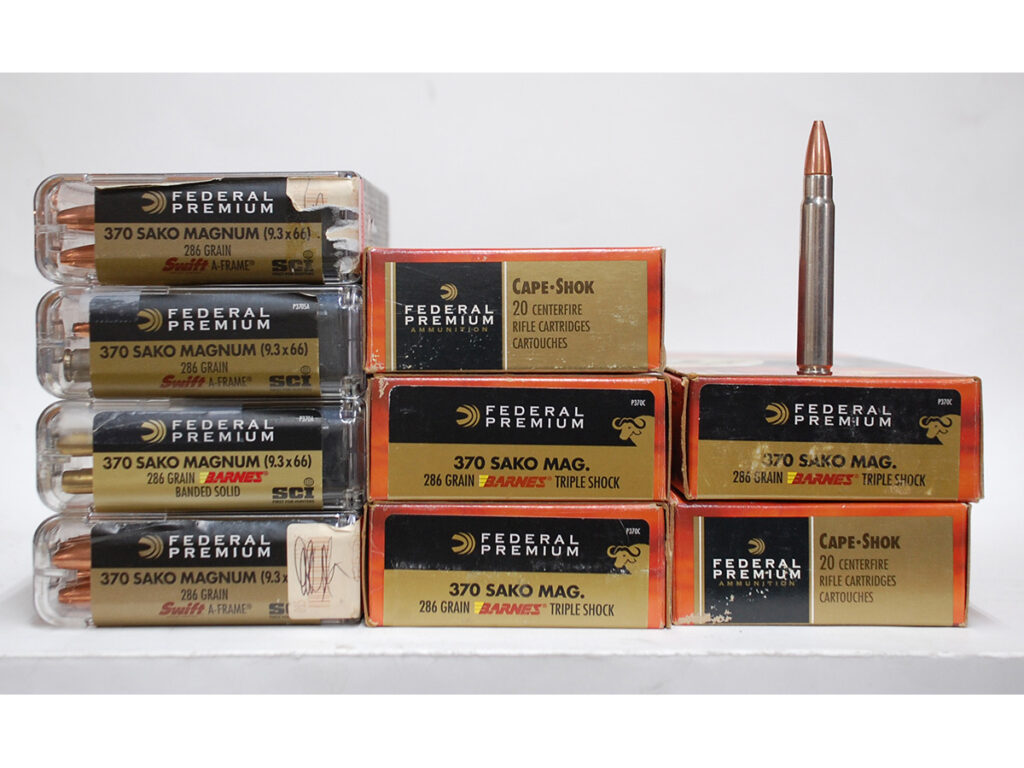
I had a good supply of 0.366-inch bullets on hand and several suitable powders, but cases were another matter. I could either shoot up some expensive factory loads, or contact Quality Cartridge, which makes top-notch brass for a multitude of rounds, including the .370 Sako. I did some of both. I also stumbled across a large stash of Federal .370 factory loads in a little gun shop, and the owner wanted rid of them, so we made a deal.
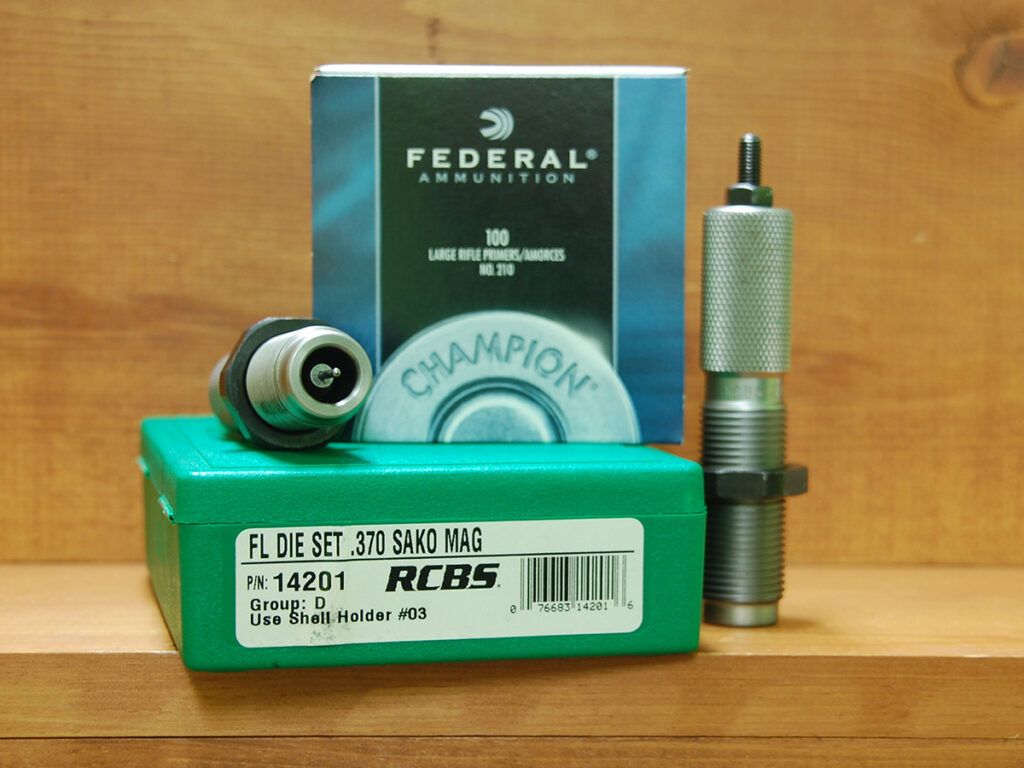
Preparing handloads for the .370 is as simple as falling off a log. If you can hand-load a .270, or .30-06, you’re set. Caution: Make sure the load data are for the .370, not the older 9.3×62. Often, data for the two cartridges are listed back-to-back, and a mix-up could be dangerous. The VihtaVuori loading manual has a good variety of load data for the .370. Set the sizer to move the shoulder back only about 0.002 to 0.003 inch for easy chambering and longer case life.
I tested 24 handloads and three factory loads in my rechambered CZ M550 at 50 yards from a benchrest in my indoor shooting building. The overall accuracy was 0.91 inch, with several loads printing groups under an inch. This precision is certainly within minute-of–buffalo.
Bullet weights ranged from 232 to 325 grains, but if I had to choose, I’d pick the Nosler 250-grain AccuBond or Ballistic Tip, and the 270-grain Speer Semi-Spitzer. Top powders for either include LeverEvoluton (LVR), VihtaVuorti N540 and N550, Ball-C(2), and CFE 223.
Velocities run at 2,500 fps for most game loads, producing a muzzle energy close to 4,000 ft-lb. The recoil is an attention-getter. In my 9-pound rifle, a 250-grain bullet at 2,500 fps produces 30.6 ft-lb of recoil. On that note, I developed two reduced loads that were uniform, accurate and did not loosen my bridgework. The Norma 325-grain Oryx Bonded over 56.0 grains of VihtaVuorti N550 or 57.0 grains of VihtaVuori N540 registered 2,123 and 2,063 fps, respectively. Accuracy was A-OK, and the recoil was noticeably reduced. If one wanted to hunt deer and similar-sized game with their 370, either of these loads ought to be suitable. Of course, one can never go wrong with a Nosler Partition, and with 66.0 grains of the new CFE 223 powder, velocity was 2,547 fps, and it grouped into .48 inch at 50 yards.
And we can’t overlook the Federal factory loads. All have 286-grain bullets. The two Barnes bullets clocked right at 2,500 fps, and the Swift A-Frame registered 2,381 fps. And there is the bonus of the once-fired, nickel-plated Federal cases for reloading.
The Bottom Line
There are many excellent cartridges for big game hunting. But for the hunter who wants something a bit different, the .370 Sako Magnum combines plenty of power, game-getting accuracy, reduced recoil, and flexible handloading potential. All in all, it’s a viable choice for the globetrotting hunter.
370 Sako Magnum Accuracy & Velocity
| Bullet | Powder Type | (Grs.) | Case | Primer | Col (in.) | Bullet Jump (in.) | Vel. (fps) | Sd (fps) |
Me (ft-lb) |
50-Yd. Acc. |
| Norma 232-grain Oryx Bonded | Viht. N540 | 68.0 | Q.C. | Fed. 210 | 3.270 | 0.223 | 2,711 | 10 | 3,787 | 1.32 |
| Norma 232-grain Oryx Bonded | CFE-223 | 68.0 | Q.C. | Fed. 210 | 3.270 | 0.223 | 2,664 | 16 | 3,657 | 0.71 |
| Norma 232-grain Oryx Bonded | Reloder 15 | 66.5 | Q.C. | Fed. 210 | 3.270 | 0.223 | 2,642 | 6 | 3,597 | 0.55 |
| Barnes 250-grain Triple-Shock-X Flat Base | CFE-223 | 65.0 | Federal | Fed. 210 | 3.574 | 0.169 | 2,595 | 12 | 3,739 | 1.30 |
| Barnes 250-grain Triple-Shock-X Flat Base | Ball-C(2) | 65.0 | Federal | Fed. 210 | 3.574 | 0.169 | 2,586 | 9 | 3,713 | 0.90 |
| Barnes 250-grain Triple-Shock-X Flat Base | LVR | 64.0 | Federal | Fed. 210 | 3.574 | 0.169 | 2,581 | 12 | 3,699 | 0.76 |
| Nosler 250-grain Accu-Bond | CFE-223 | 67.0 | Federal | Fed. 210 | 3.455 | 0.128 | 2,701 | 10 | 4,051 | 0.55 |
| Nosler 250-grain Accu-Bond | LVR | 66.0 | Federal | Fed. 210 | 3.455 | 0.128 | 2,687 | 6 | 4,009 | 1.08 |
| Nosler 250-grain Accu-Bond | Viht. N540 | 67.0 | Federal | Fed. 210 | 3.455 | 0.128 | 2,684 | 11 | 3,999 | 1.12 |
| Speer 270-grain Semi-Spitzer | CFE-223 | 66.5 | Federal | Fed. 210 | 3.360 | 0.010 | 2,578 | 4 | 3,986 | 1.30 |
| Speer 270-grain Semi-Spitzer | Viht. N540 | 66.5 | Federal | Fed. 210 | 3.360 | 0.010 | 2,571 | 28 | 3,964 | 1.18 |
| Speer 270-grain Semi-Spitzer | LVR | 66.5 | Federal | Fed. 210 | 3.360 | 0.010 | 2,544 | 11 | 3,881 | 0.51 |
| Hornady 286-grain InterLock RP | LVR | 64.0 | Federal | Fed. 210 | 3.455 | 0.032 | 2,538 | 17 | 4,092 | 0.96 |
| Hornady 286-grain InterLock RP | Viht. N550 | 65.0 | Federal | Fed. 210 | 3.455 | 0.032 | 2,530 | 5 | 4,066 | 0.68 |
| Hornady 286-grain InterLock RP | PP 2000MR | 66.0 | Federal | Fed. 210 | 3.455 | 0.032 | 2,519 | 11 | 4,031 | 0.76 |
| Nosler 286-grain Partition | LVR | 64.5 | Federal | Fed. 210 | 3.455 | 0.155 | 2,548 | 11 | 4,124 | 0.55 |
| Nosler 286-grain Partition | CFE-223 | 66.0 | Federal | Fed. 210 | 3.455 | 0.155 | 2,547 | 7 | 4,121 | 0.48 |
| Nosler 286-grain Partition | Viht. N540 | 66.0 | Federal | Fed. 210 | 3.455 | 0.155 | 2,523 | 10 | 4,043 | 1.12 |
| Norma 325-grain Oryx Bonded | Viht. N550 | 64.0 | Q.C. | Fed. 210 | 3.455 | 0.095 | 2,233 | 11 | 3,599 | 0.76 |
| Norma 325-grain Oryx Bonded | Viht. N540 | 57.0 | Q.C. | Fed. 210 | 3.455 | 0.095 | 2,123 | 10 | 3,253 | 0.73 |
| Norma 325-grain Oryx Bonded | LVR | 56.0 | Q.C. | Fed. 210 | 3.455 | 0.095 | 2,063 | 6 | 3,072 | 0.75 |
| Federal 286-grain Barnes Tripple-Shock-X | Factory Load | 3.323 | 2,498 | 6 | 3,964 | 0.83 | ||||
| Federal 286-grain Barnes Solid | Factory Load | 3.295 | 2,516 | 22 | 4,021 | 1.46 | ||||
| Federal 286-grain Swift A-Frame | Factory Load | 3.307 | 2,381 | 7 | 3,601 | 1.50 | ||||
| AVERAGE ACCURACY: | 0.91 |
Editor’s Note: This article is an excerpt of Gun Digest 2026, 80th edition.
More Rifle Ammo

Next Step: Get your FREE Printable Target Pack
Enhance your shooting precision with our 62 MOA Targets, perfect for rifles and handguns. Crafted in collaboration with Storm Tactical for accuracy and versatility.
Subscribe to the Gun Digest email newsletter and get your downloadable target pack sent straight to your inbox. Stay updated with the latest firearms info in the industry.
Read the full article here