
Do you have a drill that test your marksmanship and gun handling skills? The War HOGG Self Eval is a perfect drill to test numerous different marksmanship and gun handling skills while capturing 12 pieces of critical shooting performance data for The Firearms Training Notebook. This data will assist you in developing your dry fire training plan and improving your marksmanship skills.
The Firearms Training Notebook was developed with my co-author Mark Kelley of Kelley Defense. We had our own training notebooks, but our students did not take any type of notes for their marksmanship training. That was the birth of The Firearms Training Notebook. Today, every student, law-abiding citizen, military or law enforcement officer of War HOGG Tactical receives a copy of The Firearms Training Notebook. Our student leaves with tangible shooting performance data and a tool to build their live- and dry-fire marksmanship training programs.
[Be sure to read our article on pistol shooting drills for additional training techniques to help you improve your handgun skills.]
The War HOGG Self Eval Drill is a “performance on demand” shooting exercise with no warm-up, designed to give you an accurate read on your current marksmanship skills.
The Standard
When I first get my students at a War HOGG Tactical course, I tell them a couple of things. First, don’t be afraid to try new things. I tell them, “If you do what you have always done, you’re going to get what you always got.”

Second, they must change their mindset on the flat range and treat it like the street or real world. This is a critical part of the War HOGG Self Eval, seeing how they have two different size targets, and with future shooting drills.
My intent — especially for my law enforcement students — is to break them out of that flat-range police mentality and have them start to think on their own. This will help add to their survivability on the street.
Why This Drill Exists
The War HOGG Self Eval is a complex drill, but it is easy to set up. I wanted the drill to show students where their skill level was prior to our course, and show them their improvement during as we capture shooting performance data throughout the course.

A lot of shooters can look “fast” on the range, right up until you demand accuracy, recoil management, red dot sight acquisition, target-to-target efficiency — and all with no warm-up. The War HOGG Self Eval Drill is built to remove the excuses. It’s simple, repeatable, and unforgiving in the best way. It forces you to solve four problems at once:
You must present your pistol or draw efficiently with a red dot optic, because you’re on the clock from the start. You have to target index intelligently, because you have two different-sized targets, and this will expose whether your eyes or your gun are leading the movement. You have to manage recoil control with predictability and repeatability, last conduct a slide lock magazine change.
If you want measurable improvement instead of “I felt good today,” this drill belongs in your rotation.
Equipment Needed
- Your normal range and firearms equipment
- Live-fire range
- Dry-fire training area
- Shot timer: I recommend the PACT Club Timer III.
- The Firearms Training Notebook — available on Amazon
- Recording device and tripod or holder
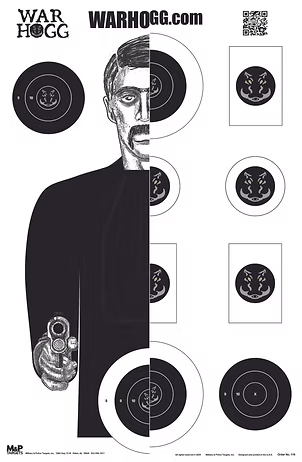
- 3×5 and 4×6 index card or the War HOGG Tactical Training Target
The Pistol
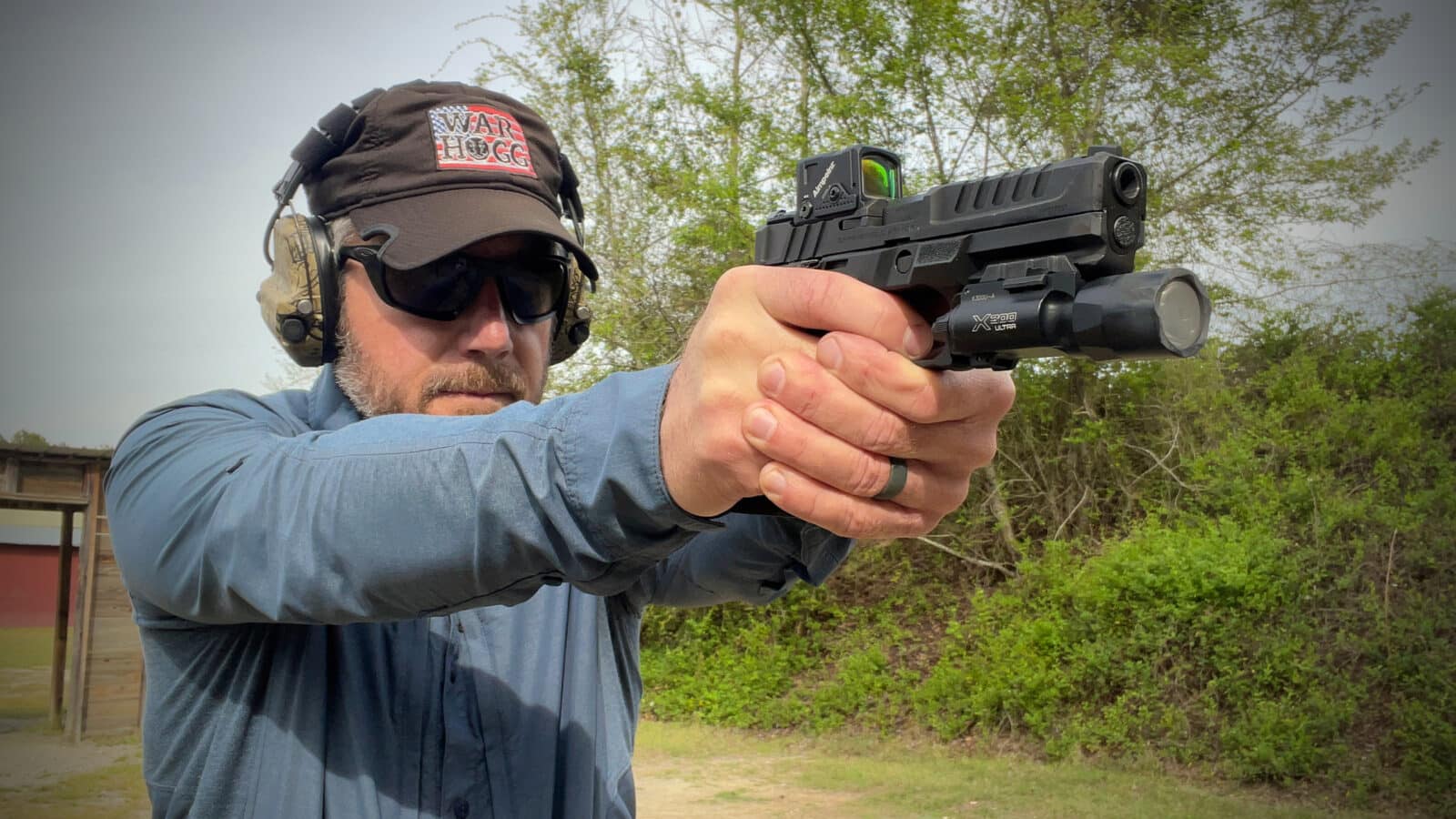
For this War HOGG Self Eval, I’ll be running the Springfield Armory Echelon 4.5F with the Aimpoint COA. The Aimpoint COA is an enclosed-emitter pistol red dot optic built around Aimpoint’s mounting ecosystem and the A-CUT interface. The COA is designed to be compact, durable, and practical for hard use — making a great match for the Echelon.
How the Skill Builder Works
At the beginning of the month, shoot the War HOGG Self Eval skill builder exercise. Remember the War HOGG standard — shoot it cold, and this will show your shooting-on-demand performance level.

After shooting the self eval, record your shooting performance data in your copy of The Firearms Training Notebook. Don’t forget the note section, as it is critical to write down anything learned during the drill. For example, if I fumbled the magazine change due to poor mag pouch placement, missed shot three because my grip fell apart, etc. Develop your dry-fire training plan from that shooting performance data and any notes gathered, and then work your dry-fire plan throughout the month.
Around the end of the month, head back out to the range and reshoot the War HOGG Self Eval skill builder and see your improvement (if you put the dry-fire work in). You could also go back to the range mid-month for a check on how your dry-fire sessions are working for your marksmanship skills.
War HOGG Self Eval Setup
For pistols, set up at 5 yards/meters with a 4×6 index card in the upper right of the target and a 3×5 index card in the lower left, spaced about 18” apart. With two magazines loaded with six rounds each, start from the ready position or draw from the holster.
How to Run the War HOGG Self Eval
On the shot timer beep, present the pistol and fire three rounds at one card, then three at the other. Conduct a speed magazine reload, then repeat the process. After completing the exercise, record your timer data in The Firearms Training Notebook.
- Shot 1 is your draw to first shot or presentation time from the ready
- Shots 2&3, 5&6, 8&9, 11&12 are your split times for that target
- Shot 4 and 10 is your target index time
- Shot 7 is your slide lock speed magazine change time.
Those 12 pieces of shooting performance data with an overall time tell a story of where your shooting performance skills are at if you needed to use your firearm to defend yourself or your family. Common areas for improvement include Shot 1, involving your pistol presentation and holster draw. Also, shot 7, which covers your magazine change. With some dry-fire practice, these skills can often show marked improvement.

People always ask, “What is the standard?” You are the standard. Establish your baseline and constantly strive to be 1% better everyday with your marksmanship and gun handling skills.
Variations
The War HOGG Self Eval can be modified in various ways to match your skill level and available firearms.
- Instead of starting from the ready position, you can add a draw from your holster, whether that’s outside the waistband, inside the waistband, a duty holster, or a combination of holster types.
- For carbine-only practice, the distance changes to 7 yards/meters.
- To practice transitions, start with the carbine. When the carbine is empty, transition to your handgun to complete the last six rounds.
Dry-Fire
If your self eval keeps breaking down in the same place, you just found your training priority. Don’t guess at fixes; use your notes and your misses to identify what’s happening, then address that specific issue in dry-fire.

The best way to improve your score is to build efficiency in your dry-fire program. Start by using your recorded times to set an initial par time that allows you to complete the sequence with clean mechanics. Then, repeat the drill in dry-fire exactly as you’d run it live. This includes:
- A repeatable draw stroke
- Eyes-first transitions
- Smooth magazine change

Live The Armory Life. The latest content straight to your inbox plus an automatic entry to each of our monthly gun giveaways!
When your mechanics are consistent under the par, reduce the par in small increments — maybe 0.1 to start. The goal is repeatable performance, not one fast rep that falls apart under stress. Dry-fire is where you remove the wasted motion and build being efficient with your gun-handling skills. Live-fire is where you validate your marksmanship and work on recoil mitigation.
The Skills
Whenever you are conducting any type of training session, either dry- or live-fire, the question should always be, “What marksmanship/gun handling skills am I improving?” Having no firearms training plan means you are just wasting your number one most precious commodity, your time! This is where The Firearms Training Notebook comes into play to build that training program.
Your Phone Is a Helpful Tool
A key piece of training equipment we all have but seldom use is our phones. I use mine to record both my live- and dry-fire sessions. It gives me a chance to see if I am being inefficient with the skill I am trying to develop.

I use a tripod with a phone mount and place the camera more right or left facing, depending on what skill I am working on. For magazine changes, I position the camera to capture the left side of my body since I’m a right-handed shooter. When drawing from the holster, I move the camera to my right side to monitor my technique with the Safariland 6360RDS level III retention holster while drawing my Springfield Armory Echelon 4.5FC equipped with an Aimpoint COA.
Have Accountability
Accountability matters in your shooting performance. You can do it alone, but having a partner, “CREW”, group, or tribe helps keep you on track. There might be something they see that you missed, and it helps with having training accountability.

If you don’t have a network, join ours. Share your marksmanship growth with the On The Range (OTR) “CREW” member’s page. My co-host, Mark Kelley of Kelley Defense, and I hold bi-monthly interactive Zoom calls with our OTR CREW members. We break down each shooter’s skill builder and even review members’ training videos live, giving immediate feedback on ways to improve.
Exclusive Discounts for Those Who Serve
Springfield Armory has a long history of supporting the men and women who protect and serve. Through its FIRSTLINE program, Springfield provides an additional way to recognize that commitment by offering eligible qualified professionals access to select Springfield Armory firearms at discounted pricing through a straightforward, streamlined process. All FIRSTLINE handguns ship with three magazines.
For law enforcement officers who are purchasing individually, programs like this can reduce the barrier to getting quality duty equipment into service, especially when the agency isn’t supplying you with a duty pistol.
Bottom Line — Put in the Work
The War HOGG Self Eval Drill is a skill builder that rewards efficiency and punishes sloppiness. It forces a clean draw or pistol presentation, disciplined transitions, good grip with recoil control throughout, and an efficient slide lock speed magazine change.
Shoot it cold. Record your time and your hits in the Firearms Training Notebook. Dry-fire with par times to make sure your seeing improvement. Then, retest to prove you improved. Because in the end, the timer doesn’t care what you meant to do, and neither does the target.
Editor’s Note: Be sure to check out The Armory Life Forum, where you can comment about our daily articles, as well as just talk guns and gear. Click the “Go To Forum Thread” link below to jump in!
Join the Discussion
Featured in this video



Read the full article here