
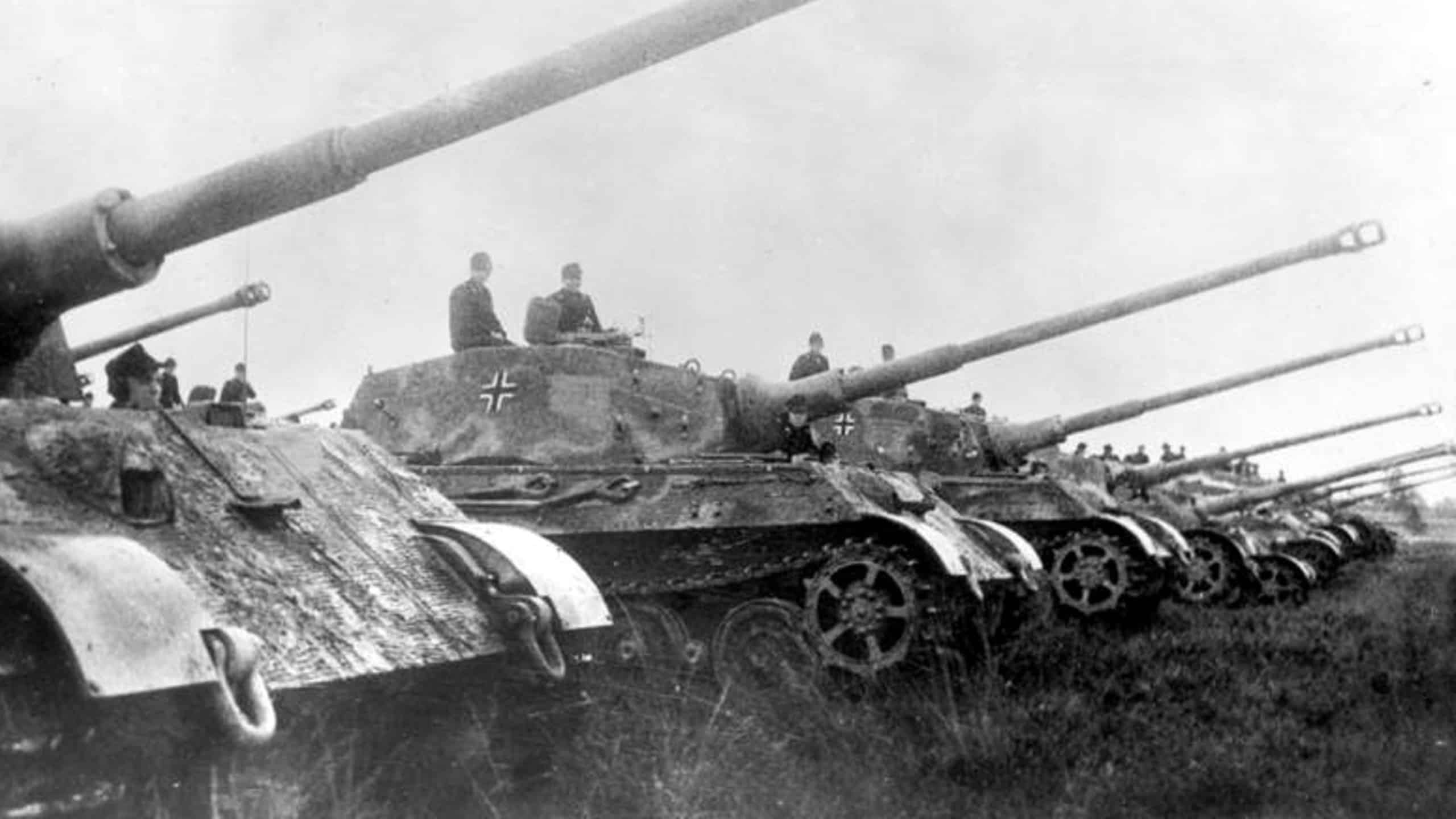
The Tiger II tank, officially designated as Panzerkampfwagen Tiger Ausf. B and introduced in 1944, was Germany’s most advanced heavy tank of World War II. Known as the Königstiger (King Tiger) by the Germans and often referred to as the Royal Tiger by Allied forces, it was designed to dominate the battlefield with unmatched firepower and armor.
While the Tiger II boasted many superior specifications, its operational impact was limited by mechanical issues, fuel shortages and Germany’s deteriorating war position.
Design Origins of the Tiger II Tank
The Tiger II’s development began in 1943, as German engineers sought to improve upon the Tiger I tank’s strengths while addressing its weaknesses. The original Tiger I had already demonstrated the value of heavy armor and the powerful 88mm gun, but its vertical armor was vulnerable to angled shots, and its mechanical reliability was poor. The Soviet T-34 tank’s sloped armor and mobility had impressed German designers, prompting a shift in design philosophy.

Two companies, Porsche and Henschel, submitted competing prototypes. Porsche’s VK 45.02(P) featured a rear-mounted turret and an electric transmission powered by twin gasoline engines. While innovative, it was complex and relied on copper, which was in short supply. Henschel’s VK 45.03(H) offered a more conventional front-mounted turret and mechanical transmission, prioritizing reliability and ease of production. Henschel’s design was ultimately selected.
The turret, designed by Krupp, was initially curved and intended for Porsche’s chassis. When Porsche’s design was rejected, the first 50 Tiger IIs used this turret on Henschel hulls. However, the curved front created a shot trap and was difficult to manufacture. Krupp redesigned the turret with a flat front and simplified geometry, improving ballistic protection and production efficiency. This production turret (erroneously called the “Henschel turret”) became standard from mid-1944 onward.
Tech Specs and Armament
The Tiger II was a massive vehicle, weighing nearly 70 tonnes. It was powered by a Maybach HL230 P30 V-12 gasoline engine producing 700 horsepower. Despite its size, the tank could reach speeds of up to 41.5 km/h (25.8 mph) on roads, though off-road performance was limited. Its operational range was around 170 km, but fuel shortages often reduced this in practice.

The tank’s suspension used torsion bars and overlapping road wheels, which provided a smooth ride but were difficult to maintain. The transmission offered eight forward and four reverse gears, allowing for precise maneuvering but prone to breakdowns under stress.
Armor protection was exceptional. Its frontal glacis plate, an angled section of hull armor designed to deflect incoming rounds, was 150mm thick and sloped at 50 degrees, enhancing its effective resistance. The turret front was even more robust, reaching 180mm in thickness. Side armor ranged from 80mm to 120mm, offering substantial defense against flanking attacks. This combination of heavy and sloped armor made the Tiger II nearly impervious to frontal assaults from Allied tanks and anti-tank weapons, reinforcing its reputation as one of the most heavily armored vehicles of World War II.
Live The Armory Life. The latest content straight to your inbox plus an automatic entry to each of our monthly gun giveaways!
Its main armament was the 8.8 cm KwK 43 L/71 gun, a longer and more powerful version of the Tiger I’s gun. With a muzzle velocity exceeding 1,000 m/s, it could penetrate over 200mm of armor at 1,000 meters. Secondary armament included two 7.92mm MG34 machine guns, one coaxial and one in the hull.
The Tiger II carried around 86 rounds for the main gun and over 5,000 rounds for the machine guns. The five-man crew, consisting of commander, gunner, loader, driver, and radio operator, required extensive training to operate the tank effectively.
Tiger II Production and Deployment
Production of the Tiger II began in January 1944 and continued until March 1945. Due to Allied bombing, material shortages and manufacturing challenges, only 492 units were built. These tanks were assigned to heavy tank battalions (schwere Panzer-Abteilungen) of the Wehrmacht and Waffen-SS.

The first Tiger II tanks were deployed in Normandy in July 1944 by the 503rd Heavy Panzer Battalion. They later saw action in the Battle of the Bulge, Operation Panzerfaust and on the Eastern Front. The 501st Heavy Panzer Battalion received Tiger II’s for combat against Soviet tank forces, where they faced the formidable IS-2 and massed T-34 formations.
Deployment was often hampered by logistical issues. The tank’s weight made transport difficult, and its wide tracks limited mobility on narrow roads. Many Tiger II’s were lost not to enemy fire but to mechanical failure, fuel shortages or abandonment.
Battlefield Performance and Limitations
The Tiger II’s battlefield performance was a mix of awe-inspiring power and frustrating limitations. Its gun could destroy any Allied tank at long range, and its armor made it nearly invulnerable from the front. In open terrain, it was a deadly adversary.

However, its mechanical reliability was poor. The drivetrain and suspension were overstressed by the tank’s weight, leading to frequent breakdowns. Spare parts were scarce, and field repairs were difficult. Fuel consumption was extremely high, and Germany’s dwindling fuel supplies meant many Tiger II heavy tanks were immobilized.
Mobility was another issue. The tank was slow to accelerate and difficult to maneuver in urban or forested terrain. Its size made it a target for aircraft and artillery, and its inability to retreat quickly often left it vulnerable.

Despite these flaws, the Tiger II had a psychological impact. Allied crews feared encounters with the King Tiger, and its reputation often exceeded its actual battlefield effectiveness. In skilled hands and favorable conditions, it could dominate engagements, but those conditions would be increasingly rare by 1944–45.
Tactical Role and Strategic Impact
The Tiger II was designed as a breakthrough tank, intended to lead assaults and crush enemy defenses. However, by the time it entered service, Germany was largely on the defensive. This mismatch between design intent and strategic reality limited its tactical utility.

Heavy tank battalions attempted to use the Tiger II in concentrated formations, but terrain and fuel shortages disrupted these plans. In the Battle of the Bulge, Tiger II’s were deployed in spearhead units but were slowed by poor roads and logistical constraints. On the Eastern Front, they were used to counter Soviet armored thrusts but were often overwhelmed by superior numbers and air support.
Strategically, the Tiger II was a drain on resources. Its high production cost, maintenance demands, and logistical burden made it unsustainable. While it could dominate localized engagements, it could not alter the course of the war. Germany’s industrial base was collapsing, and the Tiger II became a symbol of over-engineering in a time of desperation.
Combat Engagements
Although the Tiger II was introduced late in World War II and produced in limited numbers, it saw action in several major battles across both the Western and Eastern Fronts. These engagements showcased its strengths in firepower and armor, but also exposed its vulnerabilities in mobility and logistics.
One of the earliest and most notable deployments occurred during the Battle of Normandy in July 1944. The 503rd Heavy Panzer Battalion fielded Tiger II’s against Allied forces near Caen. While the tank’s frontal armor proved impervious to most Allied weapons, the terrain and Allied air superiority limited its effectiveness. Several Tiger II’s were lost not to enemy fire but to mechanical failure and fuel shortages, highlighting the logistical challenges of deploying such a heavy vehicle.

On the Eastern Front, the Tiger II was first issued to the 501st Heavy Panzer Battalion, which engaged Soviet forces in the summer of 1944. In battles near Sandomierz, Poland, Tiger II’s faced off against Soviet T-34/85’s, IS-2’s, and ISU-122’s. Despite their superior firepower, many Tiger II’s were destroyed or abandoned due to poor terrain and flanking attacks. The Soviets captured several intact units, allowing them to conduct extensive testing at Kubinka and assess the tank’s capabilities firsthand.
In October 1944, Tiger II’s played a key role in Operation Panzerfaust, a German effort to maintain control over Hungary. The 503rd Heavy Panzer Battalion supported Otto Skorzeny’s troops in securing Budapest, helping to ensure Hungary remained aligned with the Axis powers. The battalion then participated in the Battle of Debrecen, where Tiger II’s were credited with destroying over 120 Soviet tanks and hundreds of artillery pieces. However, losses were high. Many Tiger II’s were destroyed by enemy fire or deliberately blown up by their crews to prevent capture.

The Tiger II saw its largest concentration of use during the Battle of the Bulge in December 1944. Nearly 150 Tiger II’s were deployed across four heavy tank battalions. These tanks spearheaded assaults through the Ardennes, aiming to break Allied lines and reach Antwerp. While they initially achieved tactical successes, poor road conditions, fuel shortages and stiff resistance stalled the offensive. Many Tiger II’s were lost during the retreat, either destroyed in combat or abandoned due to mechanical failure.
In the final months of the war, Tiger II’s were used in defensive actions across Germany and Austria. They fought in the Battle of Berlin, where remnants of heavy tank battalions attempted to repel Soviet advances. By this stage, the tanks were often deployed piecemeal, with little logistical support and dwindling ammunition. Despite their formidable design, they could not stem the tide of Allied forces closing in from both east and west.
Tiger II Legacy & Historical Significance
The Tiger II remains one of the most iconic tanks of World War II. Its design influenced post-war tank development, especially in terms of armor and firepower. The tank’s reputation for invincibility, though not entirely accurate, left a lasting impression on both Axis and Allied forces.

Several Tiger II’s survive today in museums, including examples at the Bovington Tank Museum in the UK and the Kubinka Tank Museum in Russia. These preserved vehicles offer insight into the engineering challenges and ambitions of wartime Germany.
In popular culture, the Tiger II continues to fascinate historians, modelers and enthusiasts. It appears in documentaries, video games and historical literature, often portrayed as the ultimate expression of German armored might. Its legacy is both technical and symbolic. It’s a reminder of how innovation can be both brilliant and flawed.
Final Thoughts
The Tiger II was a paradox. It was a tank of unmatched firepower and protection that was ultimately undermined by its own complexity and the strategic collapse of Nazi Germany. While it never fulfilled its intended role as a decisive battlefield weapon, it remains a showcase of the extremes of wartime engineering.
Its legacy endures not just in military history but also as a cautionary tale. The Tiger II shows that even the most powerful weapon is only as effective as the strategy, logistics and infrastructure that support it. It stands today as marvel and monument to the challenges of war, as well as a reminder of the limits of ambition.
Editor’s Note: Please be sure to check out The Armory Life Forum, where you can comment about our daily articles, as well as just talk guns and gear. Click the “Go To Forum Thread” link below to jump in!
Join the Discussion
Read the full article here