


The Brief:
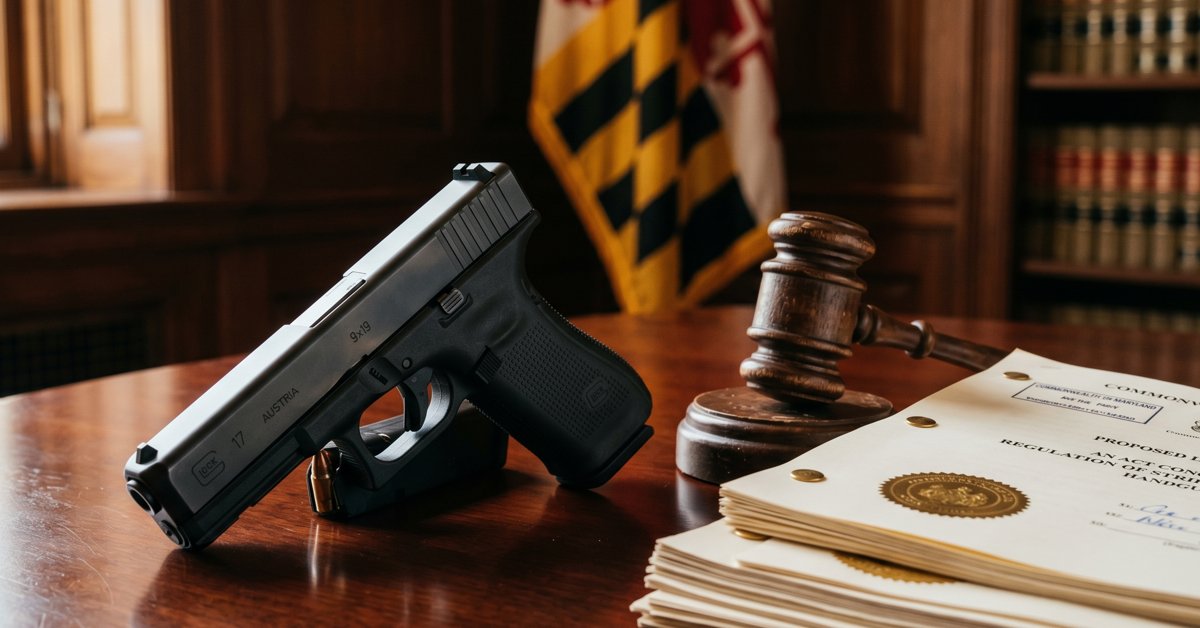
Governor Wes Moore signed Senate Bill 334, prohibiting the sale and manufacture of many striker-fired handguns in Maryland starting January 2027. The law targets pistols with cruciform trigger bars, classifying them as convertible to machine guns. This legislation effectively bans popular firearm models used by many law-abiding citizens.
In response, gun rights organizations filed a federal lawsuit challenging the measure’s constitutionality. The plaintiffs argue the ban violates Supreme Court precedents protecting firearms in common use. Legal experts expect further challenges and requests for injunctions before the law’s scheduled implementation at the start of 2027.
ANNAPOLIS, MD — The Second Amendment landscape has entered a highly volatile new phase in the Old Line State. On Tuesday, May 26, 2026, Governor Wes Moore signed SB 334 (the “Stop DIY Machine Guns Act”) into law, making Maryland the second state in the country – following California – to pass legislation holding firearms manufacturers legally liable for standard design elements.
The response from the gun rights community was instantaneous. Within hours of the governor’s signature, the National Rifle Association (NRA), the Firearms Policy Coalition (FPC), and the Second Amendment Foundation (SAF) filed a joint federal lawsuit, National Rifle Association of America v. Moore, in the U.S. District Court for the District of Maryland.
The Core of the Contention: The Cruciform Trigger Bar
While gun control advocates and corporate media outlets have framed the legislation as a targeted strike against illegal, 3D-printed “Glock switches” (auto-sears), the actual statutory text goes significantly further.
The statute specifically bans the manufacture, sale, purchase, or transfer of any semi-automatic pistol featuring a cruciform trigger bar that can be converted into an automatic weapon by replacing the slide’s backplate with a component modifier.
Because the cruciform trigger bar is a foundational internal safety component embedded in nearly every generation of Glock handguns, the single highest-selling pistol platform in the United States, the law operates as a de facto ban on the acquisition of these common defensive arms by law-abiding citizens. The legislation directs the Maryland Department of State Police to draft regulations and publish an explicit registry of prohibited handgun models before the end of the year.
The Legal Framework: Banning Arms “In Common Use”
Represented by the prestigious D.C.-based litigation boutique Cooper & Kirk, PLLC, the plaintiffs argue that the law represents a blatant violation of the historical precedents solidified by the U.S. Supreme Court in Heller and Bruen.
Under Supreme Court doctrine, the government cannot enact a blanket prohibition on an entire class of firearms that are “in common use” by millions of citizens for traditionally lawful purposes. The complaint emphasizes that handguns are the quintessential defensive tool protected by the Second Amendment text, and that the state cannot render that right hollow by outlaws of the core commercial infrastructure required to purchase them. Furthermore, the plaintiffs note a glaring logical flaw in the state’s reasoning: the conversion devices (“switches”) themselves are already strictly prohibited felonies under both the National Firearms Act (NFA) and existing Maryland state codes.
Severe Penalties Loom
If the law survives the initial waves of injunction requests, individuals found violating the transfer ban after January 1, 2027, will face misdemeanor convictions carrying penalties of up to three years in prison or a maximum fine of $5,000 per infraction. The law includes a grandfather clause allowing current legal owners to retain their personal property and transfer them strictly to immediate family members, but it completely decimates the commercial and resale market value of the firearms statewide.
Local advocacy group Maryland Shall Issue (MSI), led by President Mark Pennak, has announced that an independent companion lawsuit will be filed shortly, ensuring a multi-front defense against what the 2A community views as an existential threat to striker-fired handguns.
Safety Tip: For Maryland gun owners and retail dealers, the period between May 2026 and December 31, 2026, is an essential logistical window. Because the law grandfathered existing possession, any transfer, retail purchase, or secondary market acquisition of a Glock or related striker-fired pistol must be entirely finalized and cleared through the state police background check pipeline before the January 1, 2027 deadline. Tactically, look for Cooper & Kirk to file an immediate motion for a preliminary injunction mid-summer. If a federal judge grants the injunction, the state will be temporarily blocked from enforcing or preparing the banned list, freezing the clock while the core constitutional merits are argued in court.
Read the full article here