




Pull up almost any 20- or 30-year emergency food list and you will see the same collection of staples: wheat, white rice, corn, sugar, dried beans, pasta, rolled oats, potato flakes, powdered milk and dehydrated vegetables. Properly packaged and stored under the right conditions, some of these foods can remain usable for decades. That part is not necessarily wrong.
What almost nobody points out is that practically everything on those lists is extremely low in fat.
That is the real reason these foods last so long. They are not magical survival foods that somehow resist time. They are mostly dry carbohydrates with very little oil available to oxidize, turn rancid or develop off-flavors. Even the long-term storage guidance these lists are based on admits that cooking oil needs to be rotated every year or two, while foods such as nuts, brown rice, whole-wheat flour, dried eggs, granola and jerky are generally left out of the 30-year category.
In other words, the standard long-term food plan is not a complete food plan. It is a grain and bean reserve with a few extras thrown in. It can provide carbohydrates, some protein and a lot of bulk, but the one macronutrient that is hardest to preserve is usually treated like something you can worry about later.
That is a serious mistake. In a real long-term emergency, you may still have buckets full of wheat when your usable supply of fat is already gone.
The Dirty Secret of Long-Term Food Storage: Your Fat Supply Will Fail First
A commonly recommended basic ration is 25 pounds of grain and five pounds of dry beans per adult each month. Depending on exactly what you store, that works out to roughly 45,000 calories over 30 days, or around 1,500 calories per day.
For someone sitting around doing very little, that is already thin. For someone cutting firewood, hauling water, repairing damage, tending animals, standing watch or doing any of the physical work that comes with a legitimate emergency, it is nowhere close to enough. You are not going to rebuild a fence, defend a property or drag supplies several miles while living comfortably on 1,500 calories of boiled wheat and beans.
The bigger problem is where those calories are coming from. Wheat contains only around 2 percent fat by weight, while dry beans are often closer to 1 percent. An entire month of that basic grain-and-bean ration may provide only around 250 grams of fat. That puts fat at roughly 5 percent of total calories, far below the generally accepted range of 20 to 35 percent.
That does not mean you instantly fall over because dinner was low-fat. It means the plan becomes increasingly difficult to sustain, especially if total calories are already restricted and the work is physically demanding. Fat is concentrated energy. It helps make stored food edible, carries fat-soluble vitamins, supports hormone production and allows you to get far more calories into a meal without trying to choke down another giant bowl of beans.
There is also a documented danger in attempting to survive almost entirely on extremely lean protein. Arctic explorers and trappers described what became known as rabbit starvation or protein poisoning after trying to live on lean game without enough fat or carbohydrate. Once protein climbs too high as a percentage of total calories, the body cannot simply burn unlimited amounts of it without consequences. Diarrhea, headaches, weakness, nausea and an overwhelming craving for fat can follow.
That is why hunters throughout history valued the fatty parts of an animal so highly. A pile of lean rabbit meat could leave a person starving while technically eating plenty of protein. A fat animal could keep a family alive.
If you aim for fat to provide 30 percent of a 2,000-calorie diet, you need around 67 grams per day. Over a year, that adds up to about 54 pounds of fat, or roughly seven gallons of cooking oil, for one adult. A family of four would need close to 28 gallons to maintain that level for a full year. Even at the low end, with fat supplying only 20 percent of calories, you would still need around 35 pounds per person.
That is a hell of a lot more than the two little bottles of vegetable oil most people throw onto the pantry shelf after buying 500 pounds of wheat.
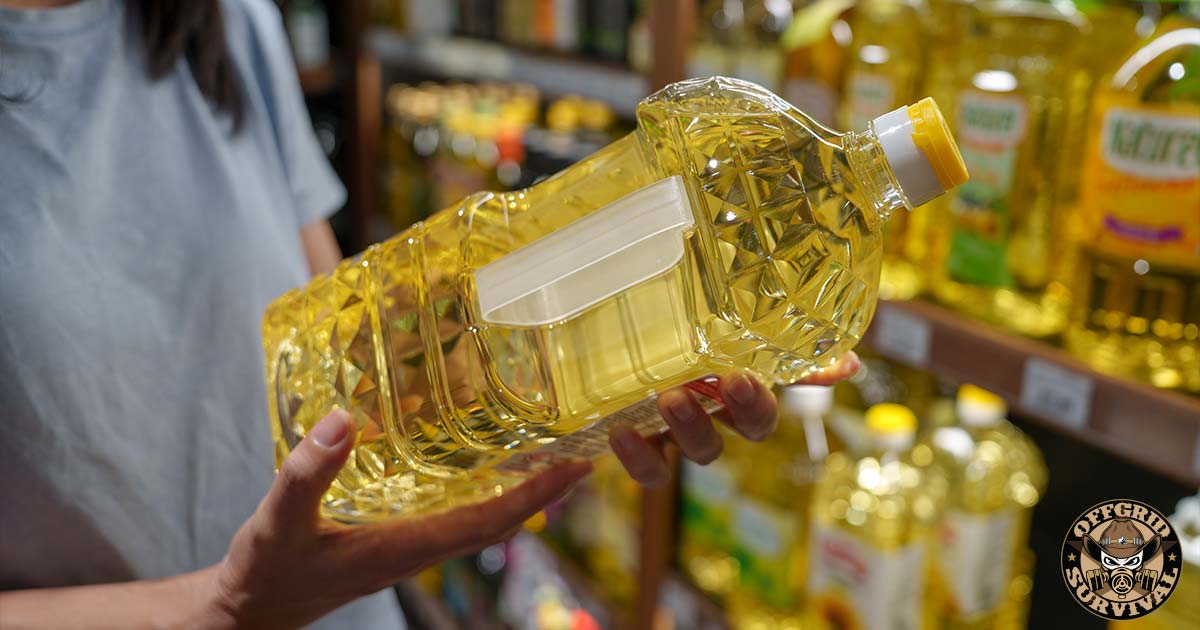
A gallon of cooking oil contains roughly 31,000 calories. That is more than half the calories found in a five-gallon bucket of wheat, packed into a fraction of the space. From a pure calorie-storage standpoint, fat is one of the most efficient things you can put away. Unfortunately, it is also one of the first things in the pantry to go bad.
Why Fat Goes Rancid
When people say an oil has gone rancid, they usually treat it as one simple process. In reality, fat can deteriorate through different chemical pathways, and understanding the difference helps explain why some fats last longer than others.
Oxidative rancidity happens when oxygen attacks unsaturated fatty acids. The reaction produces compounds that break down and continue attacking more of the fat, which is why oil can seem fine for a while and then deteriorate quickly once the process gains momentum.
The number of double bonds in a fatty acid makes an enormous difference. Oleic acid has one double bond, linoleic acid has two and linolenic acid has three. Reported oxidation rates for these fats have been estimated at roughly 1 to 40 to 100. That means a fat containing large amounts of highly polyunsaturated oil can oxidize dramatically faster than one built mostly from saturated or monounsaturated fat.
This is why flaxseed oil and fish oil can become rancid so quickly, while coconut oil, tallow and certain other saturated fats are more resistant. It is not because one company has a better-looking label. It comes down to the chemical structure of the fat.
Hydrolytic rancidity is a different problem. It occurs when water, heat or lingering enzymes split fatty acids away from the glycerol structure. Some of the free fatty acids produced during this process create the soapy, sour or vomit-like flavors associated with spoiled butter and other fats.
Coconut oil is highly resistant to oxidation because it is so saturated, but it can still deteriorate through hydrolysis if moisture gets into it. That is an important distinction because spoiled coconut oil may not smell like the harsh paint or varnish odor people associate with rancid vegetable oil. It may simply develop a strange, soapy taste.
Laboratories often measure oxidation through peroxide values. Fresh oil starts low, oxidation becomes more significant as the number rises, and values above 10 milliequivalents per kilogram are generally considered high. The Codex limit for virgin oils is 15.
You are not going to perform peroxide testing in your pantry, but the numbers make an important point: oil can be well into the deterioration process before the average person notices a powerful odor. Your nose helps, but it is not a precision instrument, and it should not be your entire storage plan.
Heat Destroys Shelf Life
The dates printed on oil bottles assume reasonably controlled storage. They do not mean the product will last that long after spending two summers in a 110-degree garage.
Fat oxidation roughly doubles for every 18-degree Fahrenheit increase in temperature. That means the difference between a cool basement and a desert garage is not minor. It can reduce the useful life of the same oil by a huge amount.
One study projected a mid-oleic sunflower oil sample to last about 120 days at 68 degrees, 60 days at 86 degrees and only 30 days at 104 degrees. The oil did not change. The container did not change. Only the temperature changed, and the predicted storage life dropped by 75 percent.
Anyone storing food in Las Vegas, Phoenix, Southern California, Texas or another hot climate needs to take this seriously. An attached garage can remain between 95 and 115 degrees for months. A shed can get even hotter. Under those conditions, a bottle advertised as having a two-year shelf life may be badly degraded in a fraction of that time.
Many long-term food storage recommendations use 75 degrees as the upper limit and warn that warmer temperatures require faster rotation. That is not legal fine print added to protect the manufacturer. It is one of the most important instructions on the page.
Preppers often spend hundreds or thousands of dollars on sealed buckets, oxygen absorbers and Mylar bags, then stack everything in the hottest room on the property. That may work reasonably well for white rice or sugar. It is a terrible way to store fat.
Coconut Oil Has a Place, but It Is Not Immortal
Coconut oil is around 90 percent saturated fat, making it one of the most oxidation-resistant fats commonly available. Lauric acid accounts for nearly half its fatty-acid content, and its iodine value is extremely low compared with lard and many vegetable oils. In practical terms, there are far fewer vulnerable double bonds for oxygen to attack.
Accelerated oxidation tests show just how large that difference can be. Flaxseed and fish oil may break down in less than two hours under high-temperature testing. Virgin olive oil may last 10 to 12 hours, while coconut and palm oil can exceed 20 hours.
That does not translate directly into years on a pantry shelf, but it does show why coconut oil is generally more stable. Refined coconut oil is commonly given a shelf life of around 18 to 36 months, while some virgin coconut oils are advertised for three to five years under proper conditions. Virgin oil may retain natural compounds that help slow deterioration, although actual life still depends heavily on manufacturing quality, packaging, moisture, temperature and how often the container is opened.
Coconut oil’s weak point is moisture. When hydrolysis releases free lauric acid, the oil can take on a soapy flavor without producing the powerful smell people expect from rancid oil.
Its melting point creates another storage issue. Coconut oil begins melting at around 76 degrees. In a hot storage area, it may liquefy during the day and solidify again at night. Repeated melting and solidification can move oxygen through the container and expose more of the fat over time.
The answer is not to panic every time coconut oil melts. It is to keep it at a steady, cool temperature instead of allowing it to cycle back and forth hundreds of times inside a hot garage.
Ghee Is Useful When It Is Made Correctly
Butter contains roughly 16 percent water along with milk solids. That moisture and remaining protein give bacteria, mold and enzymes more opportunity to cause trouble. Regular butter is not a true long-term pantry fat without refrigeration or specialized commercial processing.
Ghee is different because the water and milk solids have been removed, leaving almost pure milk fat. Commercial standards generally target moisture below 0.5 percent, with better producers pushing it below 0.3 percent. Lower moisture means less opportunity for lipase enzymes and microorganisms to ruin the product.
Proper heating does two jobs: it drives off the water and helps deactivate the enzymes that can cause hydrolytic rancidity. If the process is rushed, if the solids are not completely removed or if moisture is allowed back into the jar, the expected shelf life can drop sharply.
Research comparing production methods has found substantial differences in how long ghee remains usable. Some traditionally prepared ghee may last close to nine months under certain conditions, while ghee made through other methods may deteriorate in roughly four. The point is not that every jar expires on one exact day. The point is that technique matters.
Homemade ghee can be a useful storage fat, but it is not automatically equal to a commercially processed product. Start with clean butter, remove the moisture completely, strain out every bit of milk solid, use bone-dry containers and store it in a cool, dark location.
More importantly, do not confuse making ghee with home-canning butter.
There is no tested USDA or National Center for Home Food Preservation method for safely canning butter at home. Butter is a low-acid, high-fat food, and fat can interfere with reliable heat penetration. A pressure canner does not magically make every improvised recipe safe.
Commercially canned butter is processed with industrial equipment and validated procedures that cannot be duplicated by pouring hot butter into Mason jars on a kitchen counter. Botulism is not something you smell, taste or see before eating it. Making properly clarified ghee is one thing. Following an untested internet recipe for home-canned butter is something else entirely.
Modern Lard Is Not the Same Product Your Great-Grandmother Stored
Old accounts of farm families keeping crocks of lard through the year are often used as proof that lard has an extremely long shelf life. Those accounts may be accurate, but the pigs were not necessarily producing the same fat found in modern supermarkets.
Pigs are monogastric animals. Unlike cattle, they deposit much of the dietary fat they eat into their own body fat with relatively little alteration. Pigs also cannot synthesize linoleic acid, so the linoleic acid in their fat comes directly from the feed.
Modern hog diets are commonly based on corn, soybean meal and, in some operations, distillers dried grains. Corn oil contains a high percentage of linoleic acid, which is far more vulnerable to oxidation than oleic acid. As the amount of unsaturated fat in the feed rises, the pig’s body fat becomes softer and less stable.
The pork industry tracks this using iodine values. Higher numbers indicate greater unsaturation. Commodity pork backfat may test in the 60s, while heavy use of distillers grains can push it above acceptable processor limits. Packers care because overly soft pork fat causes production problems, produces poor bacon and has a shorter useful shelf life.
Your great-grandmother’s pig may have spent its life eating pasture, roots, garden scraps, fallen nuts and whatever else the farm produced. The lard from that animal could have been chemically different from the soft fat rendered from a modern confinement hog raised on a high-linoleic ration.
That does not make modern lard useless. It means you should stop assuming that every package labeled “lard” will behave like the product described in a 100-year-old homesteading book.
For better storage quality, look for fat from pastured or heritage pigs and ask how they were fed. Leaf lard, taken from around the kidneys, is generally firmer and cleaner in flavor than ordinary backfat. No matter where it comes from, render it carefully, remove every trace of water and protein, and rotate it rather than pretending it will last forever.
Tallow Is One of the Better Answers
Beef tallow is commonly around 50 percent saturated fat, with much of the remainder made up of oleic acid. Its polyunsaturated fat content is generally low, often around 4 percent. Lard may contain roughly three times as much polyunsaturated fat, which is one reason it often turns rancid sooner.
Cattle process feed differently from pigs. Microbes in the rumen hydrogenate much of the unsaturated fat before it reaches the animal’s tissues. Because of that, the final fat profile remains relatively stable even when the diet changes.
That does not mean grass-fed and grain-fed beef are nutritionally identical in every way. It means the basic oxidative stability of beef tallow is not as dependent on the feeder as pork fat is. Tallow from a conventional steer can still be a useful storage fat.
There are drawbacks. Tallow is hard at room temperature, can feel waxy in the mouth and carries a beef flavor that does not belong in every recipe. Most people are not going to bake cookies with it or want it in every meal.
It is still excellent for frying, cooking meat, greasing pans, making certain breads, producing soap and handling other practical jobs around a homestead. Raw suet may also be cheap if you develop a relationship with a local butcher. In some areas, processors treat it as a low-value byproduct and will sell it for a few dollars per pound.
For a preparedness plan, tallow deserves more attention than it usually receives. It is stable, calorie-dense, locally producible and relatively simple to render.
Rendering Determines Whether the Fat Lasts
Most failures in rendered animal fat come down to two things left behind in the jar: water and protein.
Proper rendering separates pure fat from connective tissue, meat fragments, blood, moisture and other material that spoils much faster. If those contaminants remain, the jar may mold, ferment, develop off-flavors or turn rancid long before clean fat would have failed.
Dry rendering uses low heat without added water. This avoids introducing moisture that must later be removed and generally produces a firmer, longer-lasting fat. Keep the temperature low, usually between 200 and 250 degrees Fahrenheit. Once you push much beyond 250, the remaining protein begins to brown and burn, darkening the fat and adding flavors that will not disappear after straining.
Wet rendering adds water and sometimes salt to reduce scorching and help extract more fat from connective tissue. It can work, but all of the water must be removed before storage. Leaving even a small layer trapped beneath the fat creates an obvious spoilage risk.
Whichever method you use, strain the finished fat more than once. Start with a metal strainer to catch the large solids, then run it through doubled cheesecloth or another fine filter. Tiny suspended particles may not look like much, but they contain protein and moisture that can shorten the life of the entire batch.
The cracklings left behind are food, not long-term storage material. Eat them promptly or refrigerate them. Do not leave them floating in the jar because you like the flavor.
Your containers must also be completely dry. A beautiful jar of perfectly rendered tallow can be ruined by a teaspoon of rinse water hiding at the bottom. When people say their rendered fat molded after a few weeks, that is often where the problem started.
Oxygen Absorbers Are Not a Magic Trick
Prepper storage methods designed for dry grains do not automatically work for fat.
Oxygen absorbers are useful in the right application. They contain iron that reacts with oxygen, reducing the amount of oxygen in a sealed package. They work well with foods that are dry, low in oil and packaged inside a real oxygen barrier.
They do not turn a plastic bucket into a permanent fat-storage system.
Standard plastic buckets allow gases to migrate through the material over time. Even nitrogen flushing or large oxygen absorbers will not overcome a container that is not a sufficient oxygen barrier. Oxygen absorbers also remove oxygen from the headspace, but they do not instantly remove all the oxygen already dissolved in the fat itself.
This is why dropping a giant oxygen absorber into a bucket of coconut oil is not the brilliant storage hack that some forums claim it is. The container still matters. The temperature still matters. Moisture still matters. The chemical stability of the fat still matters.
For long-term storage, use containers that block oxygen and seal properly. Metal cans with seamed lids are excellent when commercially packaged. Glass jars with sound gasketed lids also provide a strong barrier. Certain PETE containers with airtight screw caps may be suitable, but thin, ordinary plastic oil jugs allow more oxygen transmission than glass or metal.
Light is another problem. Ultraviolet and visible light can start oxidation reactions, which is why quality olive oil is usually sold in dark glass or metal. A clear jar displayed near a window may look nice, but it is one of the worst places to store fat.
Trace metals can accelerate oxidation as well. Copper and iron act as catalysts even at concentrations you cannot see. Do not render fat in copper cookware, stir it with rusty tools or store it against reactive bare metal.
Container size matters too. Every time you open a gallon jug, fresh air replaces the oil you poured out. Open that jug once a week and you have exposed it to fresh oxygen more than 50 times in a year. Smaller containers cost more per ounce, but they allow you to keep most of the supply sealed until needed.
For storage, the cheapest package is not always the cheapest usable product.
Build a Fat System Instead of Chasing a 30-Year Product
There is no perfect 30-year storage fat. Anyone claiming otherwise is either ignoring the chemistry, assuming ideal freezer-like conditions or selling a highly processed product whose actual manufacturer shelf life is much shorter.
Even common shortening is usually given a shelf life measured in a few years, not decades. LouAna lists about two years for refined coconut oil, while Bertolli recommends using olive oil on a much shorter timeline. Manufacturers are generally honest about this when you read their actual storage instructions instead of relying on somebody’s prepper forum calculation.
A serious plan needs three parts: rotation, reserve and production.
Your rotation supply should consist of the fats you normally use. That may include olive oil, avocado oil, coconut oil, lard, tallow, butter or shortening. Buy them in containers you can finish within a reasonable period, write the purchase date on each one, store them below 75 degrees whenever possible and use the oldest first.
Do not buy a ten-year supply of oil and then continue purchasing fresh bottles every week while the emergency stock slowly dies in the back of a closet. Stored food must move through your kitchen. Rotation is not an optional bookkeeping exercise. It is what keeps the supply edible.
Your deeper reserve can include unopened coconut oil, commercially produced ghee, commercially canned butter and shortening. Store it in the coolest, darkest area available and assume a realistic horizon of roughly two to five years, depending on the product, packaging and conditions. Inspect it, date it and set an actual rotation schedule.
Do not store more than your household can reasonably consume before it ages out. Rancid fat cannot be repaired with spices, filtering or reheating. Once it is bad, it is bad.
The final layer is production. This is where long-term resilience actually begins. Own a rendering pot. Learn to process suet and leaf fat. Find a butcher, rancher or farmer before an emergency instead of trying to establish that relationship after the trucks stop moving. If you have enough land and the ability to raise animals, understand which animals produce usable fat and how feed affects the final product.
Fat is one category where production capacity can be more valuable than another wall of storage buckets. Your wheat may last 30 years, but your cooking oil will not. Being able to render a fresh batch of tallow is worth far more than owning 20 gallons of oil that quietly went rancid three summers ago.
Your Buckets Can Be Full While Your Diet Is Failing
The survival-food industry loves the 25-year number because it sells buckets. What that number usually describes is the shelf life of the driest and leanest ingredients in the package. It does not mean every part of a healthy diet will remain nutritionally useful for a quarter-century.
That is why so many freeze-dried emergency meals are built around starches, lean meat, powdered sauces and heavily processed ingredients. Fatty cuts are difficult to preserve for the same length of time. When real fat is included, the usable shelf life tends to drop.
The label may be honest about the rice while saying very little about what the rice cannot provide.
In a prolonged emergency, you may not run out of stored food first. You may run out of usable fat while hundreds of pounds of grain and beans remain stacked against the wall. The buckets will still look full, but the meals will become less satisfying, less calorie-dense and much harder to live on while performing physical work.
After several months, the problem will not simply be that the food is boring. You may be trying to survive on around 1,500 calories per day, with only a tiny fraction coming from fat, while doing more physical labor than you did before the emergency. Fatigue, weakness, digestive trouble, weight loss and reduced work capacity are predictable results of that arrangement.
Do not wait until the grid is down to discover that you stored ingredients instead of a diet.
Count the fat in your plan. Figure out how many pounds your household would actually need. Store it somewhere cool. Buy manageable containers. Rotate it. Learn to render animal fat. Establish local sources while they are still available.
The wheat may last until 2055. Your oil probably will not. Plan accordingly.
Read the full article here


