
You have a well-made, high-quality defensive handgun. You have bought the best defensive rounds available and made sure they run in your pistol. You have a sound EDC rig that allows you to quickly and safely present your firearm, and you have trained to do it effectively. You are set, right? However, you simply cannot seem to consistently hit with the groups you think you should.
Despite the frequency with which it arises in the shooting sports, there’s a phrase that causes many experts to raise a suspicious eyebrow: “I think the sights are off.”
It’s not to say that otherwise good guns never leave the factory with alignment issues. I also don’t want to imply that adding and zeroing an optic on a new firearm is a process that’s 100% free of gremlins. But, I would say that nine times out of 10, there’s something else going on when the bullets aren’t going where the user wants, and the sights or optics are usually the least likely culprit.
If you’ve found yourself stymied by an issue you think is due to the sights or optics of your firearm, or if you know someone who’s been similarly flummoxed, this short primer should be helpful.
Knowing the Accuracy Standard
I would venture that 99% of firearms are more accurate than their owners are capable of shooting. And, from the results I’ve seen at my local ranges, I absolutely do not think that statistic is exaggerated.

Though most Springfield Armory firearms can do substantially better, a quality handgun should be able to group all of its rounds into a 4” circle at 25 yards as a baseline. Rifles are a little different, but I’ve found that the baseline level of accuracy for a bolt-action rifle should be about 2” at 100 yards, and about 4” at 100 yards if it’s a semi-auto. Yes, you should expect better from a modern, well-made firearm, but we are talking about baselines here.
Many will be pretty unimpressed by these numbers. But, to paraphrase one of my mentors from a long time ago, “Just about any firearm you come across is accurate enough to shoot the buttons off an attacker’s coat.”

Let’s work backwards from the general baseline for pistol accuracy. A 4” spread at 25 yards is about 2 and 3/4″ at 50 feet, about an inch and a half at 10 yards, and about 3/4″ at 5 yards. Just about every rifle should be printing a group of about an inch or less at 25 yards with good ammo.
When the Sights Are the Issue?
Supposing that one does need to adjust the windage or elevation of one’s sights, it will be common to encounter an appreciably small group… just not where you want it to be. If you’ve aimed dead-center at a bullseye or the middle of an “A zone” of a cardboard target, but you find that your rounds are impacting three inches high and one inch to the right, there’s a clear difference between your point of aim (POA) and point of impact (POI).

In such a case, there’s a simple trick to remember with irons: move your rear sight in the direction you want the groups to go. The front sight will work oppositely: replacing it with a taller unit will cause your point of impact to trend lower; a shorter-height front sight will cause your groups to print higher.
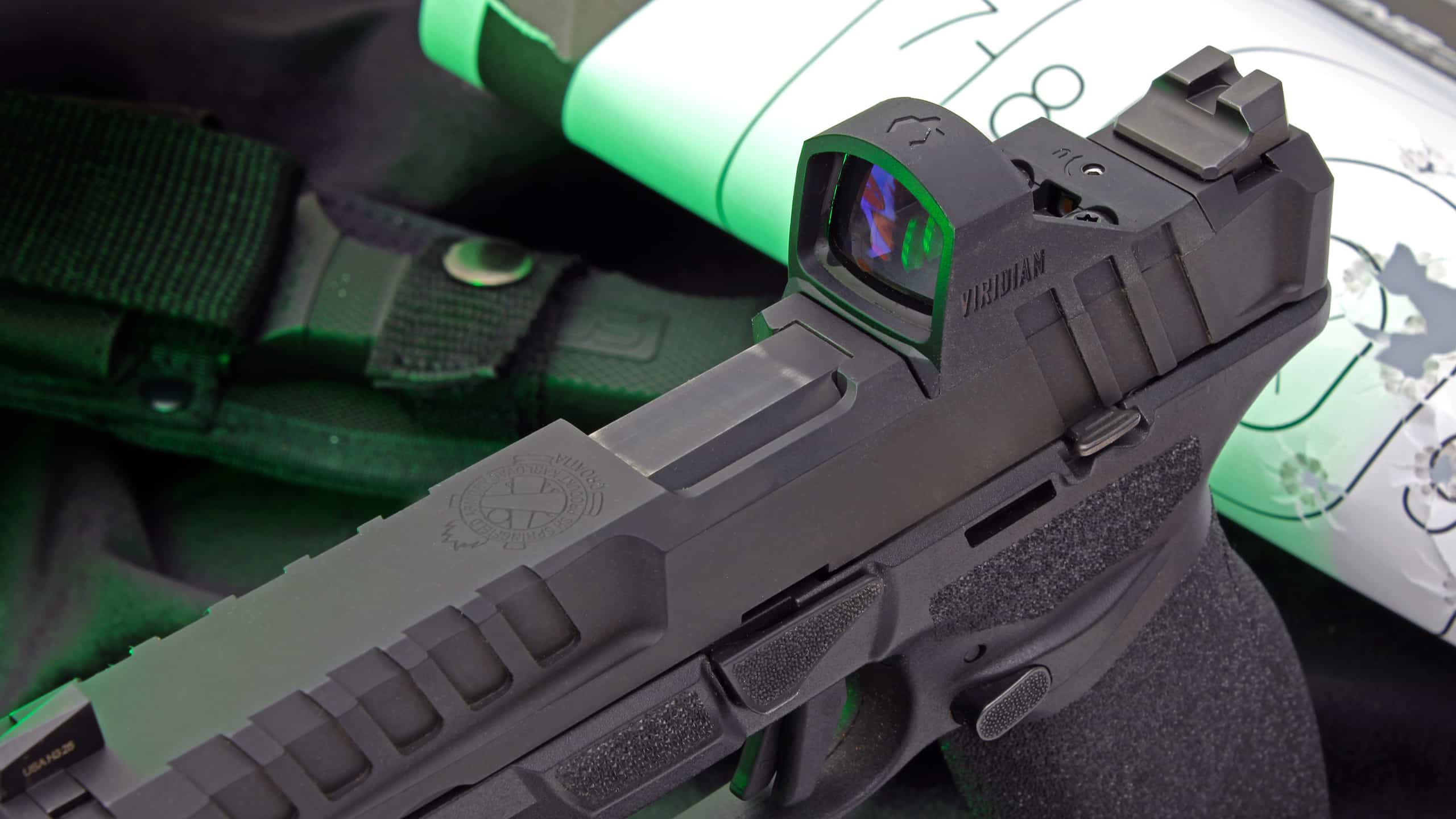
When it comes to red dots or magnified optics, it helps to read the manual or observe the markings around the adjustments. Typically, the “UP” or “LEFT” will denote the effects of your groups on target (but not always). For more information, I’d point you to one of the quality resources we have on zeroing your firearm, such as Rob Leatham’s method of zeroing a pistol or Steve Horsman’s primer on zeroing an AR-15.
When It’s (Almost Assuredly) You
If one’s group sizes are far larger than the previously mentioned benchmarks, the source of the dispersion is probably due to the person pulling the trigger.
In my neck of the woods, it’s incredibly common to encounter pistol targets in excess of 14” at the local indoor shooting range. At the outdoor range, shooters who can consistently hit a 12” gong at 100 yards offhand are rare, and the 6” steel squares at 35 yards have humbled a number of would-be pistoleros.

This all begs the question: if nearly every quality handgun or rifle is mechanically up to the task of getting hits at these distances without too much fuss, why is it so hard for shooters to execute?
Almost always, the culprit is what we often refer to in unkind words as “a flinch.” For the record, I like Massad Ayoob’s phrasing: the “pre-ignition push,” and I’ve often referred to the phenomenon as a “mash” on the trigger, which is less inclined to insult anyone’s masculinity. The inaccuracy is caused by the shooter’s attempt to control, muscle or otherwise bear down on the gun just before the shot breaks. Rounds loosely scattered around the 7 o’clock to 8 o’clock region on one’s pistol targets (assuming a right-handed shooter) are a pretty dead giveaway that the phenomenon is happening.
If this is something you suspect has crept into your shooting, there’s some good news: you’re in good company. Shooting is not easy; most of us came into this hobby thinking we’d be good at it right off the bat and were quickly humbled. Accurate shooting requires fighting millions of years of evolution; sudden, unpredictable movements and loud noises are not things our reptilian brains are comfortable with. The startle reflex produces gross muscle movement when we really want to be manipulating the trigger slowly and precisely. And, if the firearm’s recoil is uncomfortable or painful, it’s really going to increase the dispersion of rounds on target.

Live The Armory Life. The latest content straight to your inbox plus an automatic entry to each of our monthly gun giveaways!
To shrink one’s group sizes requires dedicated and thoughtful practice. Since recoil can mask bad habits, a lot of shooters simply dump hundreds more rounds on target over the course of months (or years) and lament the lack of improvement. However, those shooters who engage in self-analysis and dry-fire practice often begin seeing great results. I’ve written a larger guide to that process here. To that, I would add that mashing the trigger and muscling the gun under recoil is something that might not ever be fully cured, but it is something that can be effectively treated!
I will note that there is often a tendency for right-handed pistol shooters who habitually shoot low-left to want to adjust their sights to compensate. I would advise against this, since it will mask the results of one’s improvement: when you do pull the trigger perfectly, your round will go high and right!
Other Points of Consideration
Prior to adjusting my sights, I will normally fire a variety of groups, and on different days. Sometimes, even a one-hole group that’s just a little off-center could reflect something weird I’m doing on that particular range trip or due to some small inconsistency in my grip or trigger placement.

A point of impact/point of aim (POI/ POA) shift could also certainly be due to the difference between one type of ammunition and another. Rimfire shooters will find this phenomenon especially pronounced! Every .22 rifle and pistol tends to play favorites — often irrespective of the ammo’s cost and manufacturer. Suppose your rifle deposits one brand of ammo an inch left of your POA at your intended distance, and another brand an inch right. Where do you adjust your sights? (If you plan to shoot a lot of different ammo types interchangeably, you’d probably leave it where it is.)
Naturally, expert-level shooters will also add that anything from ambient temperatures, wind gusts, and the heat of one’s barrel can and do cause impact shifts relative to one’s original zero, but these are advanced topics for later days.

I would also add that if one still isn’t sure whether the source of inaccuracy is the gun, sights, the user, or some combination of all three, ask an experienced shooter or member of the range staff if they wouldn’t mind shooting a five-round group. Guys like us are almost always happy to help, and the results on target can be particularly instructive!
While we are talking about a lot of range use here with rifles and rimfires, it is hard to understate how important it is to make sure an EDC pistol is hitting correctly and that you can hold up your end of the bargain. Since you are responsible for every shot you fire (wherever it may land), ensuring you have a gun that you can effectively employ is a must.
Final Thoughts
In more than 20 years of shooting semi-seriously, I can recall owning maybe one or two iron-sighted firearms that did not shoot where the sights were pointed. I have, however, had a number of adjustable-sighted and scoped firearms come into my possession where the owner had clearly been chasing the sights around (and likely, to limited effect on target).

In talking to a number of new shooters, it’s certainly frustrating to feel like you’re wrangling a misbehaving gun that just won’t send rounds where you want them. The path to improvement, however, is rarely found in the fiddling of windage knobs or elevation screws.
To make a long story short, don’t feel too bad if it turns out if the source of your inaccuracy is indeed “shooter-induced” rather than equipment-related. The quest to sharpen your skills might be a long one, but few are more exhilarating. And if it is for your EDC, this is an absolute must.
Editor’s Note: Please be sure to check out The Armory Life Forum, where you can comment about our daily articles, as well as just talk guns and gear. Click the “Go To Forum Thread” link below to jump in and discuss this article and much more!
Join the Discussion
Featured in this article


Read the full article here