
![Best Tourniquets For Personal, Professional, and EDC Use [GUIDE]](https://www.recoilweb.com/wp-content/uploads/2026/03/iStock-185312058-scaled.jpg "Best Tourniquets For Personal, Professional, and EDC Use [GUIDE]")


Written by Alexander Castiglione with Joshua Vandenbrink
The National Institute of Health tells us roughly 60,000 people every year in the United States die from blood loss — and more than half of them are preventable with some form of intervention, like a way to stop the bleeding. What’s more, hemorrhage accounts for 30 to 40 percent of trauma mortality, and this stat scales globally.
A good, well-placed tourniquet is exceptional at controlling bleeding. Of course, not all hemorrhage patients are helped by tourniquets, but many are, particularly concerning lacerations or amputations to extremities.
That said, it’s the speed of it that kills. Every expert spoken to agrees one thing is for sure: If you have a bad laceration, particularly a venous or arterial one, you’re dead within minutes if you don’t stop or stem the bleeding. Car accidents, industrial accidents, and even just an oopsy at home or in the yard can be life-threatening. However, a tourniquet, when properly applied, can stop bleeding.
In the post-9/11, post-Columbine age, mass casualty events can happen anywhere. Odds are that if you are reading this, you probably carry a firearm. But do you carry a medical kit or a tourniquet? Do you know how to use one?
Real talk: Tourniquets save lives, and you should carry one. But which one? Let’s talk about the details, nuances, and products on the market.
BEST TOURNIQUETS
- Editor’s Choice: Combat Application Tourniquet (Cat) Gen 7 (TCCC Certified)
- USSOCOM TQ Of Choice: Special Operations Forces Tourniquet (Sof-T) (TCCC Certified)
- Editor’s Choice For EDC: Snakestaff Etq And Etq Wide (Pending Cotccc Approval)
- Best For K9s: Stretch–Wrap–And–Tuck (Swat-T)
- Glorified Bungee: Rapid Application Tourniquet System (Rats)
CONTEXT & HISTORY
Tourniquets, like many revolutionary medical inventions, have their origins rooted in war. In this case, we can go all the way back to Alexander the Great in the 4th century BCE. The Romans, too, used some similar devices. Key advancements in the last 2,500 years came down to the ability to measure limb occlusion pressure (LOP), which is the minimum pressure required to stop arterial blood flow. (As a reminder, veins carry blood back to the heart in a steady stream to be re-oxygenated, arteries carry oxygen-rich blood away from the heart to the extremities in short, violent spurts.)
Despite their ancient origins and technological advancements, tourniquets have historically been viewed with skepticism and apprehension within the medical community. As recently as 2003, there was medical literature that referenced the tourniquet as an “instrument of the devil that sometimes saves a life,” acknowledging its effectiveness only in highly selected tactical situations. Medics in the first Gulf War were explicitly instructed to use them only as an “absolute last resort” when all other methods failed.
These historical reservations highlight the dramatic and evidence-driven shifts in medical doctrine that occurred during modern warfighting, particularly within the realm of combat trauma care.

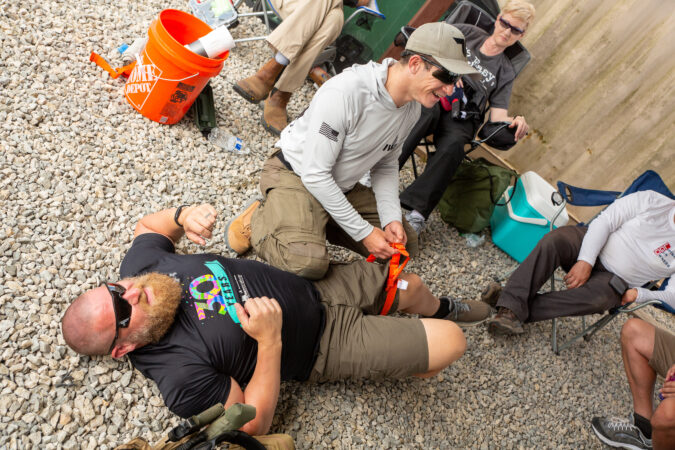
First founded briefly after the start of America’s Global War on Terror (GWOT), the Committee on Tactical Combat Casualty Care (CoTCCC, also commonly referred to as TCCC) is the golden standard when it comes to data, outcomes, and insights on the implementation and use of tourniquets in general, although they are specifically focused on the tactical context.
Data from these GWOT and surrounding conflicts demonstrated that the immediate threat of exsanguination from severe extremity hemorrhage far outweighed the risks associated with properly applied tourniquets, leading to thousands of lives saved. Advances in other arenas of medicine helped avoid the dreaded “compartment syndrome,” which is a large cause of limb loss. This fundamental change in prehospital trauma care underscores the critical importance of evidence-based medicine, especially in high-stakes environments like combat.
The evolution of TCCC effectively overcame institutional inertia, prioritizing life-saving efficacy based on real-world data, thereby transforming tourniquets from a feared device into a life-saving imperative.
TYPES OF TOURNIQUETS
There are four basic types of TQs: emergency TQs, surgical TQs, commercial TQs, and improvised. Arguably, this article is about both emergency and commercial TQs, which include all of the brands and types outlined below. We most commonly see improvised tourniquets depicted as belts or bandanas in movies, and while a lot of things can work, by definition you shouldn’t plan not to plan — things end up poorly that way.

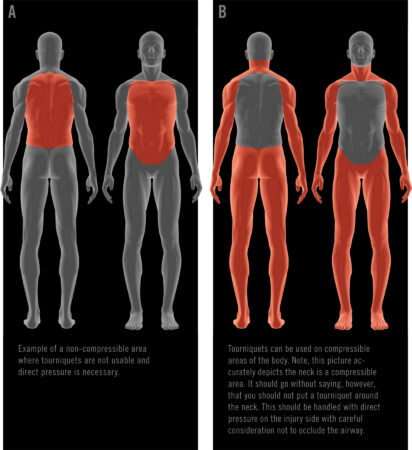
Within the realm of emergency/commercial TQs, there are different types, with essentially all TCCC-approved devices utilizing mechanical advantage in the form of a windlass or ratcheting system. While non-mechanical tourniquets like a SWAT-T or RATS can work, getting arterial or venous occlusion is paramount, and having a windlass is critical to get the compression needed.
Tourniquets function by applying circumferential pressure to a limb, which compresses the underlying blood vessels — both arteries and veins — thereby occluding or severely restricting blood flow into the distal extremity. This creates a state of ischemia, or lack of blood flow, in the tissues beyond the tourniquet. Said another way — it stops you from bleeding out or slipping into hypovolemic shock.
BEST TOURNIQUETS
MECHANICAL ADVANTAGE TQs COMBAT APPLICATION TOURNIQUET (CAT) GEN 7 (TCCC Certified)
The CAT Gen 7 is the standard of combat tourniquets and used by most LEO and MIL agencies. During GWOT, research by the Army Institute for Surgical Research (AISR) highlighted the effectiveness of tourniquets controlling bleeding and reducing mortality.

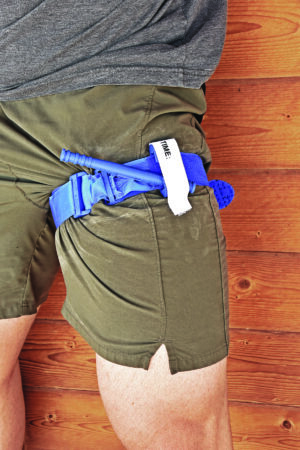
This prompted more studies and investigation into tourniquets, which had been under scrutiny for nerve damage and other tangential complications. This tourniquet was designed for single-handed use. First fielded in 2004, by 2005 it was in heavy use. It has undergone several iterative updates in the last 20 years.

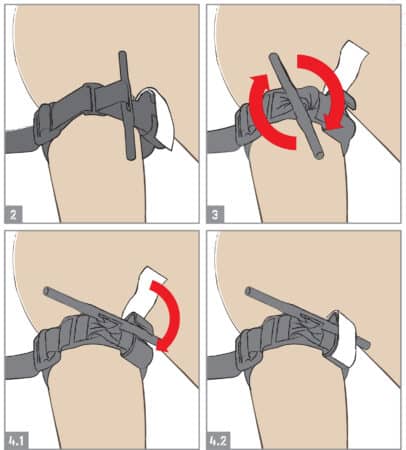
HOW TO USE:
- Step 1: Apply direct and indirect pressure on the wound. Slow the bleeding down! The hope is that you can turn a massive bleeder into a minor bleeder while you get out your TQ.
- Step 2: Route the band around the limb as high on the extremity as possible. Pass the red tip through both sides of the friction adapter and tighten the band as much as possible.
- Step 3: Twist the rod (or windlass) until the bright red bleeding has stopped and the distal pulse is eliminated.
- Step 4: Place the rod in the clip and lock it in place with the white Velcro strap. Check to be sure that the bleeding has stopped. If it has not, unlock the rod and tighten more, or apply a second tourniquet right next to the frst one, further up on the extremity if possible.
- Step 5: Always continue to reassess. Patient movement can potentially dislodge the TQ.
SPECIAL OPERATIONS FORCES TOURNIQUET (SOF-T) (TCCC Certified)
The SOF-T is the other go-to tourniquet — and for good reason. TacMed solutions, founded by a SOF Medic, developed the SOF-T based on battlefield experience. Years of feedback, testing, and research went into the SOF Tourniquet, which incorporates numerous design enhancements.

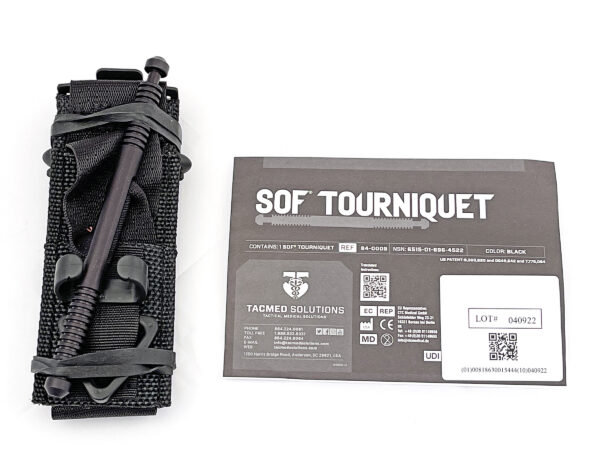
These include a Slack Indicator Wedge, which provides a clear visual aid during use; a Performance Compression Webbing, designed to maintain pressure; and a newly developed, lightweight-yet-stronger buckle.
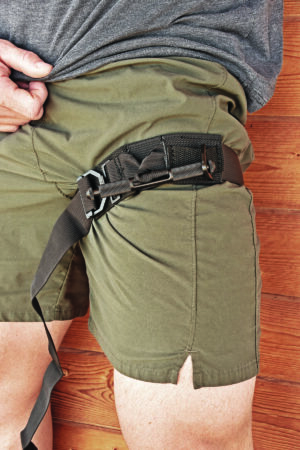
Robust enough for the most extreme conditions and portable for any situation, the SOF-T is a dependable tool. The SOFT-T is a preferred tourniquet for elite military forces and is recommended and approved by DoD.

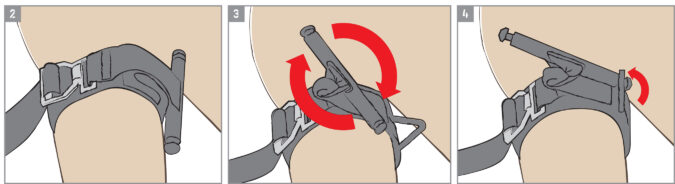
HOW TO USE:
- Step 1: Apply direct and indirect pressure on the wound. Slow the bleeding down!
- Step 2: Route the band around the limb as high on the extremity as possible. Clip the two sides of the metal buckle together; you should feel them lock in place. Take the running end of the band and pull all of the slack out of the system until the band is very tight around the extremity.
- Step 3: Twist the rod (or windlass) until the bright red bleeding has stopped and the distal pulse is eliminated.
- Step 4: Place the rod in the plastic triangle to lock it in place. Check to be sure that the bleeding has stopped. If it has not, unlock the rod and tighten more, or apply a second tourniquet right next to the frst one, further up on the extremity if possible.
- Step 5: Always continue to reassess. Patient movement can potentially dislodge the TQ.
SNAKESTAFF ETQ AND ETQ WIDE (Pending CoTCCC Approval)
A very novel tool that is currently pending CoTCCC approval, the Snakestaff ETQ and ETQ Wide are more civilian and low-viz friendly options that still have all of the hallmarks experts want to see in a tourniquet: one-handed application, mechanical advantage via a windlass, and the ability to secure the windlass.

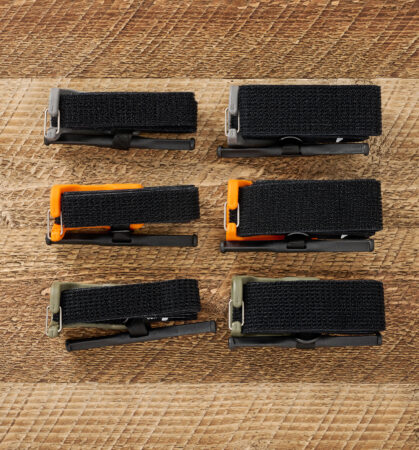
In general, many people don’t carry tourniquets due to size. While some manufacturers have recognized this and designed holster and belt attachments for CAT and similar tourniquets, size is definitely a concern for most people with a non-descript EDC.
Enter Snakestaff, who set out to make a lifesaving implement smaller. They make very cool “holsters” for their TQs, and you can easily slip an ETQ Wide in a back pocket without getting lint all over the velcro. Bonus, it looks like a pack of gum.
ELASTIC STRETCH–WRAP–AND–TUCK (SWAT-T)
Legend has it the idea of the SWAT-T popped into existence when the inventor saw footage of a resourceful-but-injured policeman in the middle of a firefight. The officer crawled over to a bicycle and removed the inner tube, then wrapped his injured limb with it, improvising a tourniquet. True or not, the SWAT-T design is versatile, multi-functional, and almost dummy-proof.
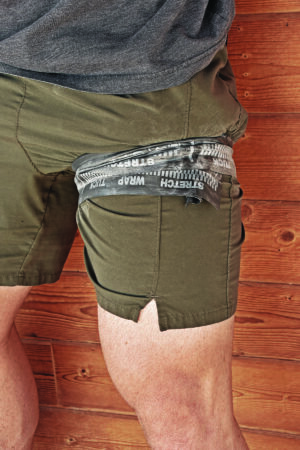
The user simply unfurls the unit and follows the directions: wrap it around a limb, stretch it until the diamonds become squares, and tuck it in. Given that it’s got a lot of surface area, there are benefits to using this over a more-compressive device like a CAT or SOFT-T, as it will minimize tissue and nerve damage. Moreover, this device can also be used as a pressure dressing, wound wrap, or even for animal applications.
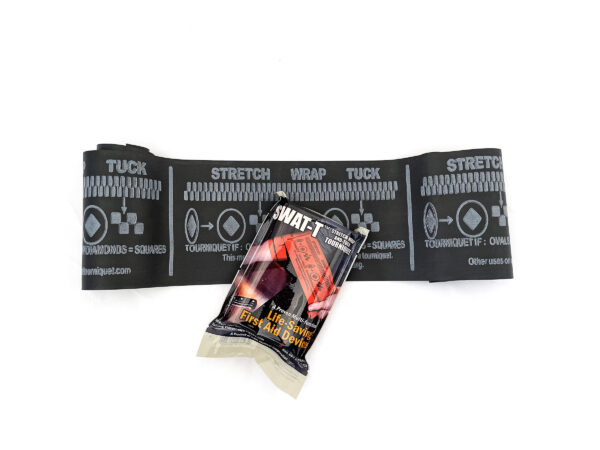
Many like these in medkits built for dogs and other animals, and not only do they work on canines as a tourniquet or form of bleeding control, but they also serve well as an impromptu muzzle. We’re told SOF veterinarians used them on their military canines for this reason as well.
RAPID APPLICATION TOURNIQUET SYSTEM (RATS)
Developed for speed and ease of application as an alternative to traditional TQs, the RATS is a simple design with a rubber core, nylon sheath, and locking mechanism.

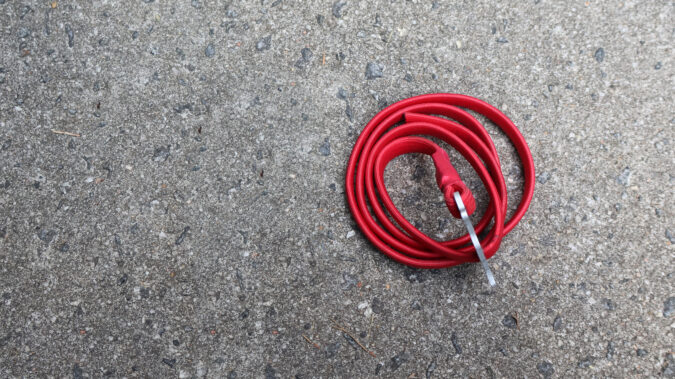
A flat, flexible cord about ½ inch in width, it’s designed to be put on quickly and easily. A user can 100 percent put this on without using another hand — and quickly.
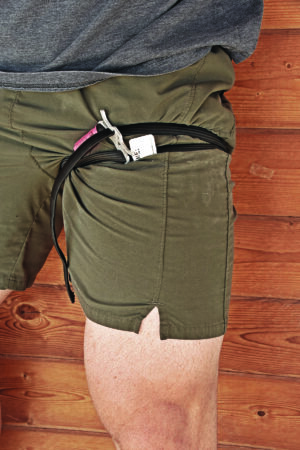
Critics of this design though will be quick to point out the lack of occlusive force exerted by essentially a bungee cord and cleat. However, it does lend itself to speed and ease of use.

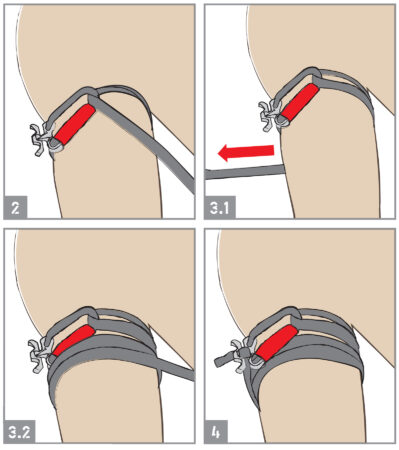
HOW TO USE:
- Step 1: Apply direct and indirect pressure on the wound. Slow the bleeding down!
- Step 2: Route the band around the limb as high on the extremity as possible. Feed the free running end of the band through the loop in the band on the cleated end, forming a hitch.
- Step 3: Using the running end of the band coming out of the hitch, continue to wrap the extremity nice and tight. You’ll need one to two additional wraps around the extremity after the frst wrap that ended at the hitch, for a total of two to three wraps of the band.
- Step 4: To lock off the tourniquet, tuck the running end of the band into the arms of the cleat all the way to the middle. For extra security, you can do both sides of the cleat. Check to be sure that the bleeding has stopped. If it has not, unlock the band and tighten more by pulling the running end and then relock it, or apply a second tourniquet right next to the frst one, further up on the extremity if possible.
- Step 5: Always continue to reassess. Patient movement can potentially dislodge the tourniquet.
MAKING ON-BODY EASIER
Carrying medical gear on your person isn’t just for EMS — and the easier it is, the more likely you are to actually do it. There are a lot of great options out there, and someone can always DIY with a little bit of forward thinking, but we found this kit to be a standout balance of size and effectiveness.
AceTac Hybrid Trauma Kit
The HTK, Hybrid Trauma Kit, by AceTac is about the size of a smartphone, and it’s like a phone case that an older person might carry on their belt. However, it comes with a boo-boo kit, a credit-card-sized multi-tool, Snakestaff ETQ Gen 2, gloves, and a QuikClot dressing.

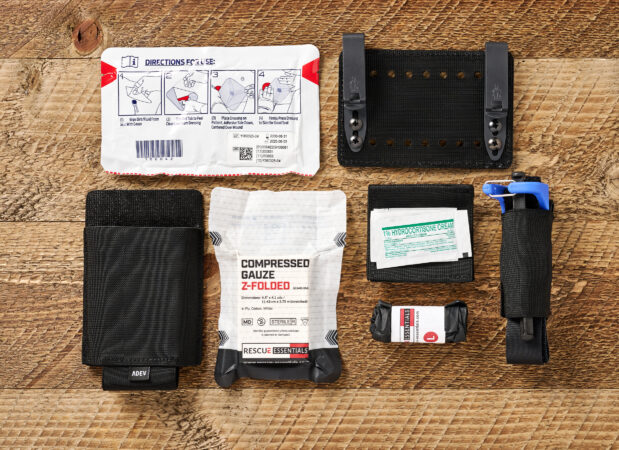
The last piece mentioned got some criticism in the market, as opposed to QuikClot gauze, but the folks at AceTac wanted to have a pre-stocked kit without a learning curve. Meaning: Your average person will not know how to pack wounds with gauze, but a tourniquet and dressing are easily used or applied by someone with minimal training.

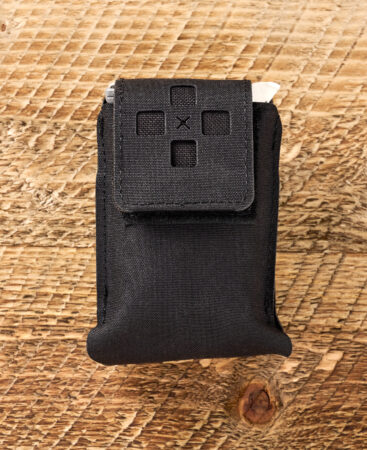
Its reinforced metal clip stays secure on your belt, and this option is particularly well suited for the colder months where a coat or big cover garment is normal.
Live The Creed EDC Pocket Trauma Kit
Another great option is the Live The Creed EDC Pocket Trauma Kit. About the size of a large and thick men’s wallet.

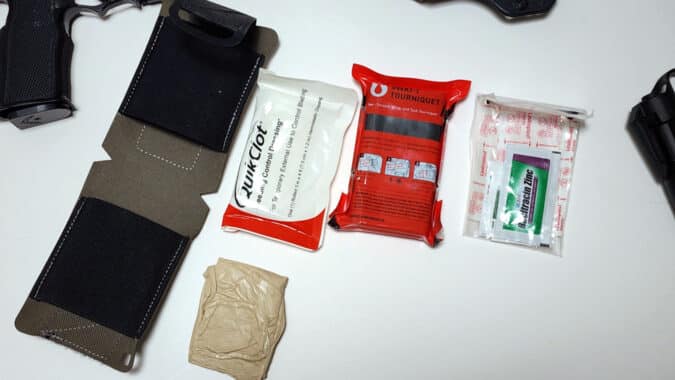
The LTC EDC kit includes:
- 1 SWAT tourniquet
- 1 QuikClot bleeding control dressing
- Tan XL nitrile gloves
- 1 bandage kit
- Wound closure strips
- 1 pack of iodine wipes
- 1 pack of alcohol wipes
- 1 tube of Bacitracin ointment
All of this fits in a package that is easy to drop into a cargo pocket with room to spare.

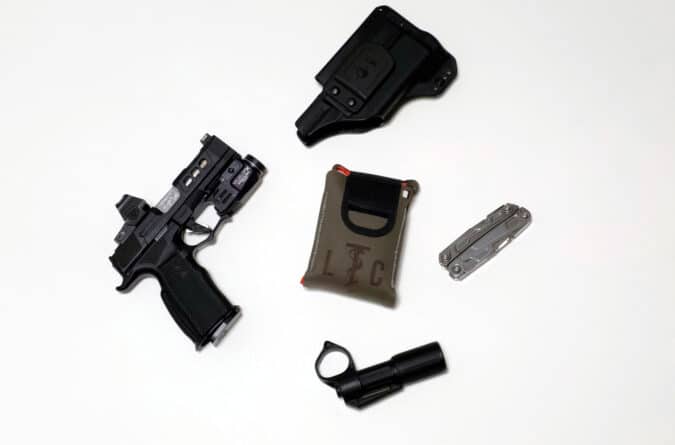
Both of these kits might benefit from an extra band-aid or two, or even a small packet of everyday meds like ibuprofen. Both kits include enough room for some minor customization.
TOP 5 TQ MISTAKES:
- Applying tourniquets to minor wounds that can be controlled with less aggressive means.
- Weak understanding of tourniquet fundamentals, resulting in improper application (such as applying it too low on a limb rather than as close to the torso as you can).
- Failing to apply the tourniquet tight enough to prevent blood from entering the extremity and/or exiting the wound.
- Waiting too long to apply the tourniquet and failing to use direct pressure throughout the application process.
- Failure to reassess after the initial application. Tourniquets can fail, so constantly reassess to determine if you need to tighten, adjust, or add a second tourniquet when appropriate.
LOOSE ROUNDS
The time to learn when to use a tourniquet is not when you need one. Stop The Bleed courses are available both virtually and in-person (definitely go in-person if at all possible), along with other basic lifesaving courses.
Since our founding in 2012, RECOIL remains the premier firearms lifestyle publication for the modern shooting enthusiast. We deliver cutting-edge coverage of guns, gear, accessories and technology. We go beyond basic reviews, providing no B.S. buyer’s guides, hands-on testing and expert analysis on everything from firearms and survival equipment to watches and vehicles.
Our reviewers are the backbone of our operation and come from diverse shooting backgrounds: Former law enforcement, military veterans, competitive shooters, seasoned hunters and plain old firearms enthusiasts. Furthermore, we’re not just gun experts, but dedicated journalists who adhere to the strictest standards of our profession.
At RECOIL, editorial independence is the foundation of everything we publish and the cornerstone of reader trust. Our editors, writers and content creators make all editorial decisions independently, free from outside influence. That boils down to: advertisers don’t dictate our coverage, the outcomes of our reviews or what we recommend in our buyer’s guides. First and always, our commitment is to our audience—ensuring every review and article is accurate, unbiased, and driven by real-world experience.
Whether you’re selecting your next firearm, upgrading your gear, or exploring the latest innovations in the shooting world, RECOIL provides the trusted insights you need to make informed decisions. Learn more about our Editorial Standards and how we review products.

NEXT STEP: Download Your Free Target Pack from RECOIL
For years, RECOIL magazine has treated its readers to a full-size (sometimes full color!) shooting target tucked into each big issue. Now we’ve compiled over 50 of our most popular targets into this one digital PDF download. From handgun drills to AR-15 practice, these 50+ targets have you covered. Print off as many as you like (ammo not included).
Get your pack of 50 Print-at-Home targets when you subscribe to the RECOIL email newsletter. We’ll send you weekly updates on guns, gear, industry news, and special offers from leading manufacturers – your guide to the firearms lifestyle.
You want this. Trust Us.
Read the full article here